- With smartphone prices climbing and consumers increasingly scrutinizing upgrade justifications, value for money has never been more crucial. OEMs must now deliver meaningful, perceptible advancements that tangibly elevate the user experience and credibly support higher price tags.
- This trend strongly favors the Accessible Flagship segment ($700 - $999 wholesale) – the fastest growing tier globally – where cutting-edge features once reserved for flagship models are now being strategically democratized into the lower price-tiers. Key brands to watch are Samsung, Xiaomi, Google, HONOR, Motorola, and OPPO.
- At MWC Barcelona 2026, leading OEMS signaled a clear innovation direction: next-generation chipsets, professional-grade imaging and high-efficiency batteries have become essential, especially as AI adoption accelerates across everyday smartphone use.
- The winners will be those who successfully integrate cutting-edge hardware with deeply optimized AI software into accessible flagship devices, delivering not just affordability, but a cohesive, premium-grade experience that truly justifies every dollar spent.
Smartphone Prices Will Inevitably Increase in H1 2026
Memory prices are skyrocketing due to insatiable demand for high-performance memory (HBM and DDR5) to power AI operations and data centers, coupled with a decline in legacy DDR4 manufacturing. Having already increased by 40-50% in Q4 2025, memory prices are expected to surge a further 40-50% in Q1 2026 and another 20% in Q2 2026, fundamentally impacting the BoM (Bill of Materials) for smartphone OEMs.
As an example, for a smartphone priced at around $800 (wholesale), memory now accounts for as much as 40% of the total BoM; a threefold increase compared to a year ago. We estimate that by the end of Q2 2026, the BoM cost of a premium device will increase by more than $150 compared to Q1 2025. This will potentially push the final retail price up by more than $200 (an increase of 25% or more).
BoM Change Example for $800 Smartphone

Accessible Flagship Will be a Key Battleground in 2026
A key trend in 2025 was the growth of the Accessible Flagship tier ($700-999 wholesale). Globally, this was the fastest growing tier in 2025, with sales increasing by 25% versus 2024. This growth was driven by three regions – Middle East & Africa, Latin America and Europe – where the tier grew by 54%, 34% and 33%, respectively, in 2025. There was also strong growth in Southeast Asia, where the tier grew by 14% year-onyear. Western Europe in particular is a key market for this tier, where Accessible Flagship smartphones became the most popular in 2025, accounting for almost 30% of the market.
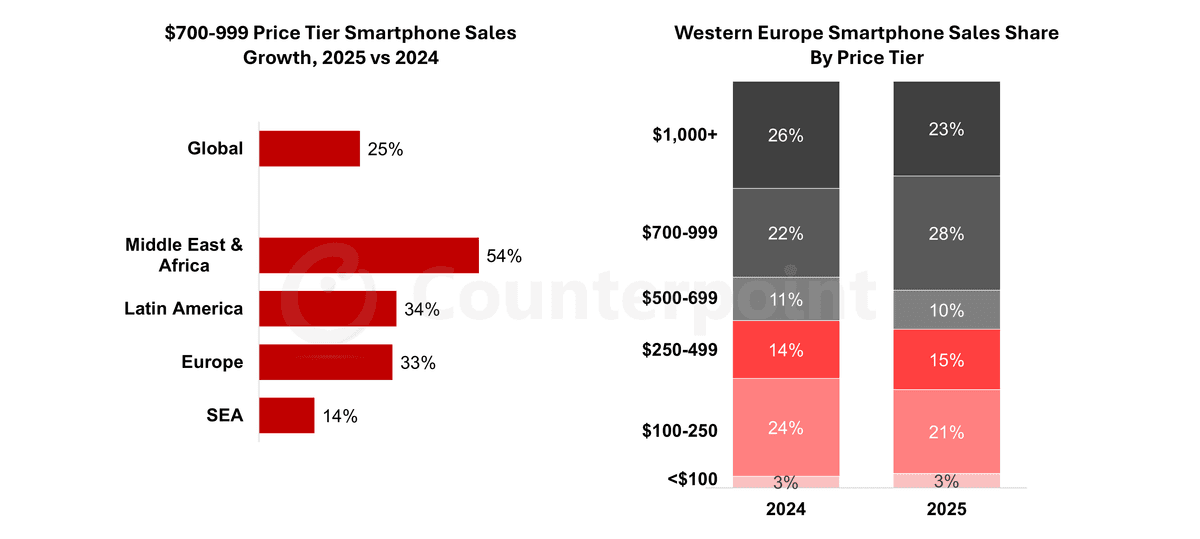
A key reason for the growth of this tier is that these devices strike a delicate balance between value for money and performance. This is proving attractive to many consumers around the world, especially in this challenging financial climate, who want premium features but are unwilling or unable to stretch to a flagship device.
The question is, can these devices continue to be so popular in 2026 following the inevitable price rises? This is where the right strategy is essential. In order to continue to win these customers over, OEMs need to show that they can still offer value for money and provide consumers with the biggest bang for their buck. Iterative upgrades have been an issue for consumers for a while now, but this is no longer an option. It will be hard to justify a price rise if the upgrade on the previous generation is not sufficient.
OEMs Have an Opportunity to Showcase Value for Money
There have been two major smartphone launches in the Accessible Flagship segment so far this year: the Samsung Galaxy S26 and the Xiaomi 17. The Xiaomi 17 kept the same launch price as the Xiaomi 15 with an improved processor, battery and screen, although the upgrades are not significant. It is a similar story with the Samsung Galaxy S26, which features a larger battery, increased base storage and a more efficient processor than the Galaxy S25, albeit for a 10% increase in price.
In general, these devices are likely to suffer from the lingering perception that they are iterative upgrades on their predecessors, and the Samsung Galaxy S26 especially will likely not sell as well as the Galaxy S25 given the increase in price.
This presents an opportunity for future launches in the Accessible Flagship tier, for example from other OEMs such as Google, Motorola, OPPO, and HONOR in particular. HONOR has seen considerable growth of its Accessible Flagship sales outside of China over the last few years, with a notable acceleration in 2025 driven by the 400 series which showcased significant camera, battery and AI feature upgrades over the 200 Series. This growth was driven by Southeast Asia, Middle East & Africa, Latin America and Europe, where, when comparing the first three quarters of availability, sales of the HONOR 400 Series increased by 333%, 319%, 215% and 107% respectively, versus the 200 Series.
HONOR Number Series Sales and Growth by Key Region (m)

HONOR’s strategy has been particularly successful in Malaysia, where it has rapidly expanded its smartphone presence and has established itself as a top choice for consumers. Throughout 2025, HONOR’s sales increased significantly in the country, where it is now the number one OEM in terms of total smartphone sales. This was helped by its growth in the premium segment, especially the Accessible Flagship tier, where it overtook Google and Xiaomi to become the second largest Android OEM. HONOR is now challenging Samsung for leadership of the Android Accessible Flagship tier.
Malaysia Android Smartphone Sales Share, $700-999 Price Tier

With Samsung increasing prices of the Galaxy S26 and other OEMs already confirmed to be doing the same for future launches, specs will be front and center in convincing consumers to part with their cash. Replacement rates are already lengthening, and value for money is more important than ever.
At MWC Barcelona 2026, leading OEMS signaled a clear innovation direction: next-generation chipsets, professional-grade imaging and high-efficiency batteries have become essential. These upgrades come at a time when AI usage has surged in smartphones, with on-device processing of every token demanding greater power efficiency and smarter hardware-software co-design.
These cutting-edge features once reserved for flagship models are now being strategically democratized into the lower price-tiers.
Premium Will be the Only Bright Spot in 2026
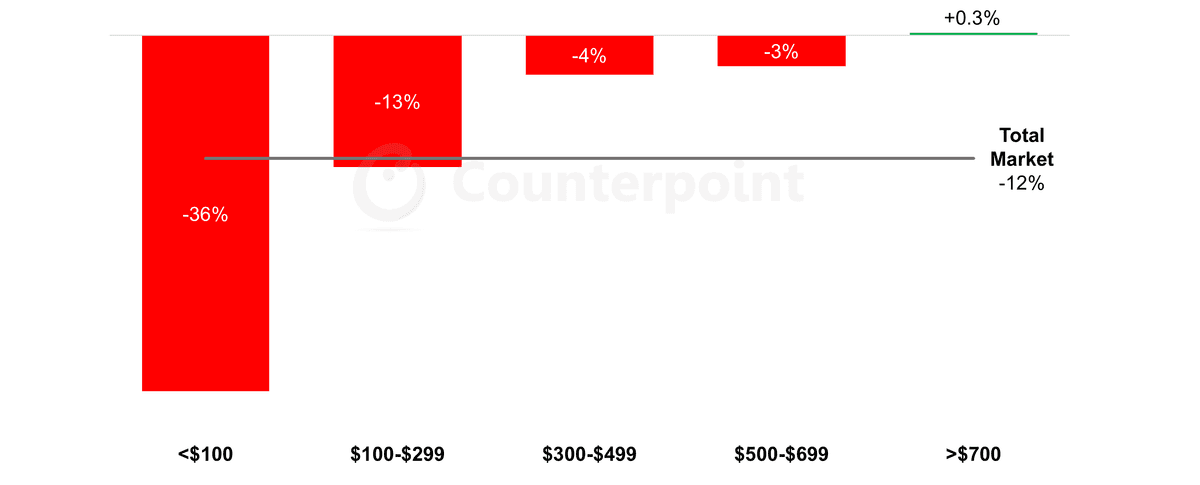
The memory price crisis will hit the smartphone industry hard in 2026, and we forecast shipment to drop by 12% YoY – the single largest annual drop in smartphone history. The decline will be felt most strongly by the lower tiers, where memory accounts for a larger proportion of the overall cost of the device. The sub$100 tier, for example, will be decimated, with over a third written off the market in 2026. The only area where we see growth, albeit slight, is in the premium tier (over $700 wholesale). But this will only happen if the devices are attractive enough. As OEMs raise prices, they will need to gamble and take the hit on margins and improve specs enough to stand out in an increasingly competitive field.
Global Smartphone Shipment Growth Forecast by Price Band, 2026 vs 2025