- Smartwatches have transformed from basic step counters to a regulatory-cleared health companion, marking a shift from being a lifestyle accessory to a regulated health monitoring device.
- Apple marked a turning point in 2018 with the first FDA-cleared smartwatch ECG.
- Others smartwatch players followed suit, gaining approval for sleep apnea, hypertension notifications, and loss of pulse detection.
- Smartwatch brands are researching non-invasive blood glucose monitoring amid FDA warnings against unapproved devices.
Introduction: The Blurring Line Between Gadgets and Medical Devices
Smartwatches have evolved far beyond simple step counters, transforming into sophisticated health monitors that blur the line between everyday lifestyle gadgets and medical equipment. By integrating advanced sensors with machine learning, they are now beginning to address chronic conditions such as hypertension and sleep apnea, which affect billions of people worldwide. As these wearables increasingly claim to detect serious health issues, regulatory bodies like the US Food and Drug Administration (FDA) have stepped in to ensure consumer safety. In many cases, the FDA categorizes these smartwatch features as lower‑risk Class II medical devices. This regulatory oversight empowers users with continuous, accessible health insights while ensuring that these tools do not replace professional clinical diagnoses.
Why do regulations matter?
Regulatory approvals play a crucial role in ensuring that the offered medical features are safe and accurate by requiring clinical validation, which helps avoid dangerous false readings. They also enable consumers to access continuous health data over the counter, turning devices into early warning tools for issues like sleep apnea and atrial fibrillation. Additionally, clearance confirms that this data is trustworthy enough to share with clinicians, closing the gap between daily self‑monitoring and proactive, data‑driven medical care.
Beginning of the Smartwatch Regulatory Journey:
The journey began when brands realized that wearables could address major public health crises, like heart disease and strokes. As smartwatches added advanced sensors, like photoplethysmography (PPG) and electrocardiograms (ECG), to detect conditions like atrial fibrillation (AFib), they crossed the threshold from simple fitness trackers into actual medical devices. This shift needed FDA oversight to guarantee patient safety and accuracy. Tech giants willingly pursued these rigorous clearances to transform their gadgets into reliable, life-saving health monitors. By securing formal FDA permissions, companies could legitimately market their devices as powerful tools for early disease detection, simultaneously empowering patients and unlocking a new healthcare market.
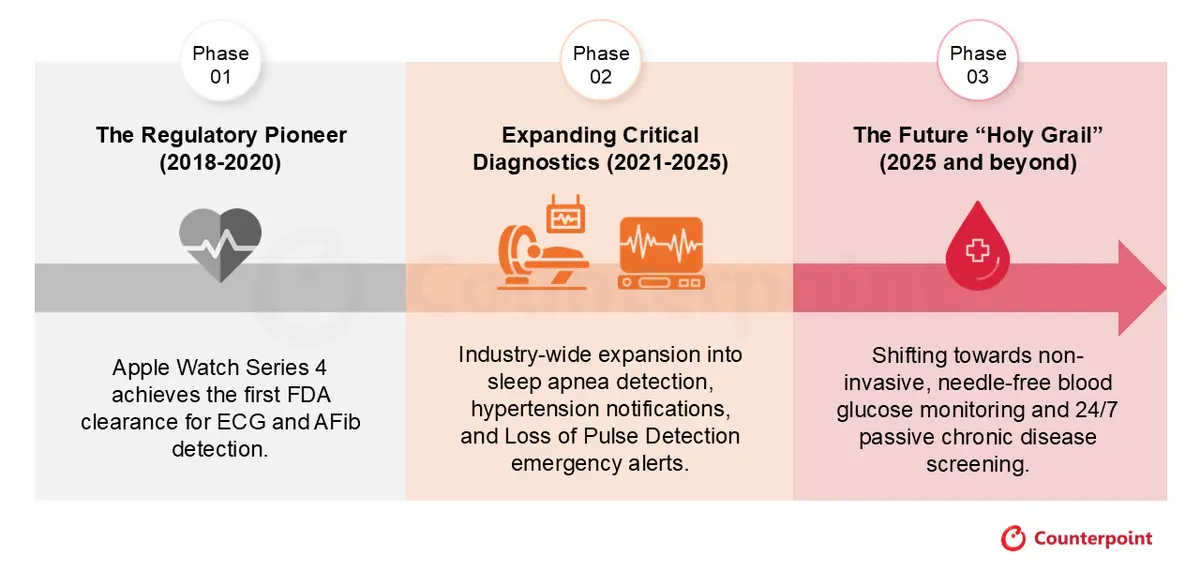
From Step Counters to Lifesavers: The Evolution of Medical Smartwatches
Source: Counterpoint Research
Apple the Pioneer:
While third-party accessories like AliveCor's KardiaBand secured FDA clearance for Apple Watch compatibility, Apple itself achieved the first major consumer smartwatch regulatory milestone. In 2018, the Apple Watch Series 4 made history with a pioneering FDA De Novo clearance for its built-in electrocardiogram (ECG) monitor. This breakthrough enabled consumers to capture medical-grade heart readings directly from their wrists without immediate physician oversight. Apple's landmark success established an industry benchmark, inspiring competitors such as Samsung, Google, and Fitbit to pursue similar approvals.
Following Suit – A Global Race for Regulatory Clearance:
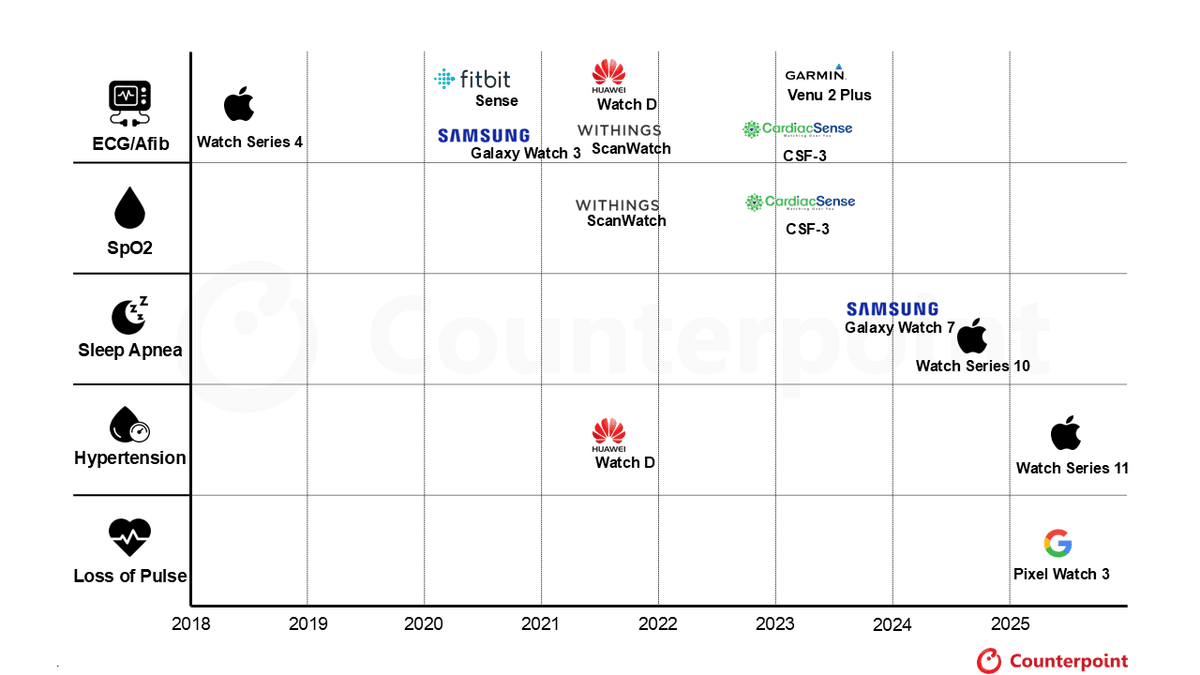
After Apple secured the first FDA clearance for detecting AFib, competitors rushed to match this capability. Interestingly, several brands conquered international regulators before the US FDA. Withings launched its hybrid ScanWatch with CE medical certification in Europe in 2020, later gaining FDA clearance in late 2021 for both ECG and blood oxygen (SpO2) monitoring. CardiacSense gained the CE mark in 2021 before receiving the FDA clearance for ECG, heart rate, and SpO2 monitoring in 2023. Competition intensified as companies pursued regulatory approvals for a diverse array of medical conditions.
- Samsung earned approval from South Korea's Ministry of Food and Drug Safety in October 2023 for its “Sleep Apnea” detection feature, months before winning FDA De Novo authorization for the same condition in February 2024.
- Following its 2020 ECG clearance, in February 2025, Google received groundbreaking FDA clearance for a "Loss of Pulse Detection" feature on the Pixel Watch 3 to alert emergency services during cardiac arrest.
- Apple also secured FDA nods for sleep apnea (2024) and “hypertension notifications” (2025).
- Huawei obtained EU Medical Device Regulation (MDR) clearance in 2023 for its Watch D2's cuffless blood pressure monitoring capabilities.
- OPPO secured Chinese National Medical Products Administration (NMPA) Class II certification in 2020 for the Watch ECG Edition's ECG detection.
- Garmin also entered the medical space by securing FDA clearance for an ECG app in early 2023.
Evolution of Smartwatch Medical Clearances, 2018-2025
Source: Counterpoint Research
Note: The list is not exhaustive
Currently, smartwatches have reached a regulatory milestone, evolving everyday wearables into potentially life-saving medical devices. Recent clearances now address complex conditions like sleep apnea, hypertension, and loss of pulse detection. However, regulators remain cautious, recently issuing strong warnings against unauthorized devices claiming non-invasive blood glucose measurement.
What's Next in the Regulatory Pipeline?
The smartwatch industry is shifting from basic screening toward comprehensive chronic disease management. The next goal is non-invasive blood glucose monitoring, which could revolutionize diabetes care through optical sensors enabling needle-free measurements. Apple and Samsung are both in the research phase to develop this technology. Garmin has also filed patents for estimating long-term HbA1c trends via light-based sensors, though this remains in early development. Current timeline estimates suggest the technology will appear in 2027-28.
Another key focus is continuous, cuffless blood pressure monitoring. While Apple and Samsung currently provide periodic hypertension notifications or spot checks, Samsung is investing heavily in true continuous tracking, targeting rollout within five years. According to the WHO, 1.4 billion adults (aged 30-79) have hypertension. However, 44% (almost 600 million) are unaware of their condition, and only 23% (roughly one in five) have their blood pressure successfully managed and controlled. With changing lifestyles, consumers are becoming more health-conscious, and regulated devices such as smartwatches will certainly be increasingly adopted for early diagnosis.
Beyond cardiovascular and metabolic health, smartwatches also serve as continuous health monitoring hubs, delivering digital biomarkers to supplement traditional clinic visits. Studies like WATCH-PD show Apple Watches identifying Parkinson’s symptoms years ahead of clinical diagnosis, and the KAIST Digital Twin research using circadian rhythm data to forecast depressive episodes and burnout in shift workers.
As ongoing studies conclude in the coming years, smartwatches could enable personalized neurological treatments and risk prediction. These evolving digital ecosystems will integrate seamlessly with electronic medical records and cloud-based clinical platforms, creating new revenue streams via remote patient monitoring (RPM) and decentralized clinical trials. However, this progress also raises major concerns. The wearables industry must address regulatory challenges and inaccuracies from unauthorized devices, while dealing with critical data privacy risks, along with the secure storage and protection of sensitive health data against hacking and its potential misuse.


