

- Global average smartphone DRAM reached 8.4GB in December 2025, up from 7.4GB in December 2024.
- Apple’s average DRAM reached almost 10GB in December 2025 with the iPhone 17 Pro series upgraded.
- Average DRAM in the premium ($≥600) segment reached around 11GB in December 2025.
- 12GB DRAM is becoming standard for high-end smartphones, offering sufficient capacity for heavy multitasking and on-device LLM execution.
Seoul, Beijing, Boston, Buenos Aires, Fort Collins, Hong Kong, London, New Delhi, Taipei, Tokyo – February 26, 2025
Global average smartphone DRAM reached 8.4GB in December 2025, up from 7.4GB in December 2024, according to the Counterpoint Handset Model Sales Tracker. OEMs largely kept memory configurations stable throughout 2025 instead of increasing the capacity across portfolios. Most of the upgrades were focused on the premium segment. As existing capacities met performance needs across most price bands. In 2026, memory cost and supply constraints are shifting OEMs’ focus from specification upgrades to margin protection.
Memory shortages are reshaping Bill of Materials (BoM) economics at current memory prices. Memory’s share of the Bill of Materials (BoM) has risen sharply, reaching over 10% of the iPhone 17 Pro Max BoM in 2025, compared with 8% for the iPhone 12 Pro Max in 2020. For flagships configured with 16GB-24GB LPDDR5X RAM and 512GB-1TB UFS 4.0 storage, memory can account for more than 20% or more of total BoM with the current price hikes.
Global Average Smartphone DRAM by Price Band, Brand and Region, Dec 2024 vs Dec 2025
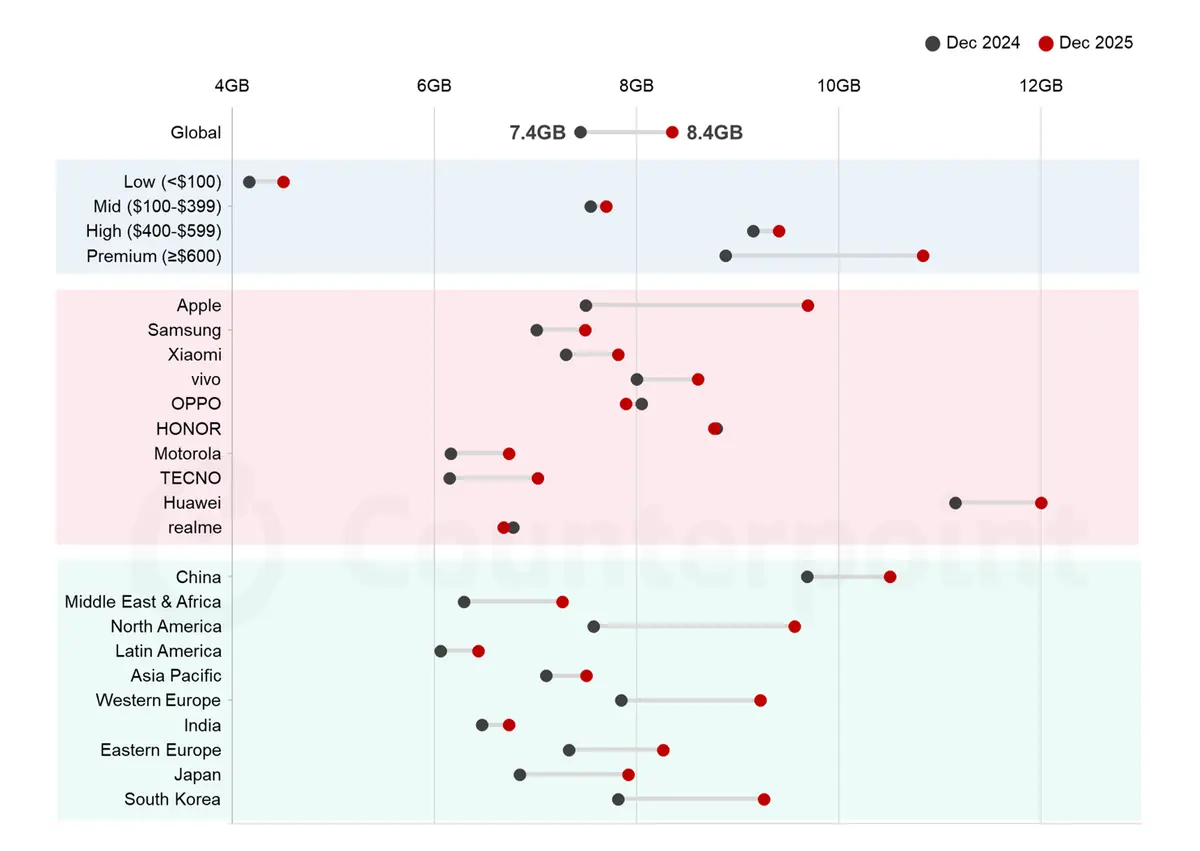
Source: Counterpoint Research Global Monthly Model Sales Tracker, Dec 2025
Commenting on the market trends, Research Director Tarun Pathak said, “Apple’s average smartphone DRAM reached almost 10GB in December 2025, marking a record YoY increase of 2.2GB, driven by the iPhone 17 Pro series upgrade to 12GB. For years, Apple increased memory gradually and relied on software optimization to offset lower DRAM capacity. By shifting to higher-capacity, high-speed memory, Apple is preparing iPhones for Apple Intelligence and enabling large AI models to run locally.”
Among major smartphone brands, Huawei recorded the highest average DRAM capacity at 12GB in December 2025, driven by its focus on the premium segment in China. In the China market, specification upgrades remain a core strategy for maintaining market share and reinforcing premium positioning. Huawei now offers 12GB to 16GB of DRAM as standard across its flagship models.
Commenting on DRAM growth across price bands, Senior Analyst Karn Chauhan said, “Average DRAM in the premium ($≥600) segment reached around 11GB in December 2025 due to the iPhone 17 Pro series. Apple’s dominance, holding over 70% of the segment sales units, has narrowed the historical memory gap with Android flagships. Following the premium segment, the low-end (<$100) tier recorded the second-highest YoY growth in average DRAM, rising 8%, while the mid- ($100-$399) and high-end ($400-$599) segments grew 3% and 2%, respectively.”
The low- and mid-range segments are expected to face the greatest impact, as legacy DRAM supply is unlikely to return in the short to medium term. Due to these segments’ price sensitivity and lower margins, OEMs cannot easily pass higher memory costs to consumers without affecting sales. To maintain profitability, they are downgrading other components, including camera modules, displays, and audio systems, with some entry-level models reverting to lower DRAM configurations.
Commenting on the memory supply and market strategy, Research Director MS Hwang said, “OEMs are adapting to memory shortages by shifting to LPDDR5 chipsets, reducing memory content or adjusting product mixes. As memory is a passive component tied to processors, demand will quickly migrate once low-cost LPDDR5 chipsets become widely available.”
In 2026, 12GB DRAM is becoming standard for high-end smartphones, offering sufficient capacity for heavy multitasking and on-device LLM execution. However, with memory shortages increasing its share of the BoM, OEMs are prioritizing margin protection over aggressive specification upgrades. As a result, most flagship portfolios are maintaining 2025 memory configurations, with significant increases limited to ultra-premium tiers.
This strategy is clearly visible in the Samsung Galaxy S26 lineup. By removing the 128GB entry variant, Samsung has increased the starting price to $899, helping offset higher memory costs without a direct like-for-like price increase. The S26 Plus carries most of the pricing pressure, with increases of $100 to $180 across storage options, making it the main model for margin recovery. In contrast, the S26 Ultra 256GB has remained flat at $1,299, anchoring the value of the ultra-premium tier. Overall, the S26 lineup highlights how OEMs are using portfolio structure and pricing mix, rather than DRAM upgrades, to manage rising memory costs while keeping consumer pricing optics stable.
About Counterpoint Research
Counterpoint Research is a global market research firm specializing in products across the technology ecosystem. We advise a diverse range of clients – from smartphone OEMs to chipmakers and channel players to Big Tech – through our offices located in the world's major innovation hubs, manufacturing clusters and commercial centers. Our analyst team, led by seasoned experts, engages with stakeholders across the enterprise – from the C-suite to professionals in strategy, analyst relations (AR), market intelligence (MI), business intelligence (BI), product and marketing – to deliver services spanning market data, industry thought leadership and consulting. Our core areas of coverage include AI, Automotive, Consumer Electronics, Displays, eSIM, IoT, Location Platforms, Macroeconomics, Manufacturing, Networks and Infrastructure, Semiconductors, Smartphones and Wearables. Visit our Insights page to explore our publicly available market data, insights and thought leadership, and to understand our focus, meet our analysts and start a conversation.

