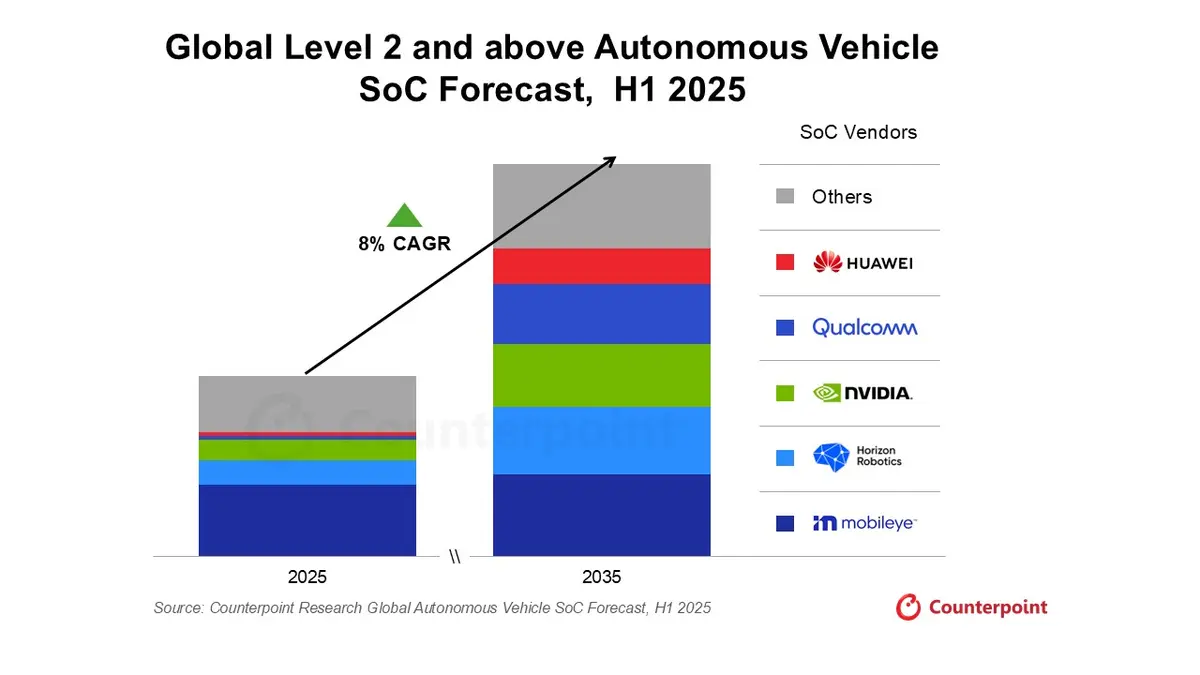
- The top 5 SoC players – Mobileye, NVIDIA, Qualcomm, Horizon Robotics and Huawei – will achieve a 78% market share by 2035 up from 69% in 2025.
- The global Level 2 and above market is expected to grow at 8% CAGR by 2035 to achieve 84% penetration; L2+ autonomy is expected to grow significantly in China, with North America and Europe becoming fast followers, providing NVIDIA, Qualcomm and Mobileye with growth and market share gains.
- Chinese SoC players Horizon Robotics and Huawei are expected to dominate the domestic market with over 50% market share by 2035.
Beijing, Berlin, Buenos Aires, Fort Collins, Hong Kong, London, New Delhi, Seoul, Taipei, Tokyo –October 16, 2025
Global Autonomous Vehicle System-on-Chips (SoCs) are entering a fast-growth phase that will reshape supplier market shares among global suppliers. Mobileye, NVIDIA, Qualcomm, Horizon Robotics and Huawei will emerge as the top 5 SoC suppliers for ADAS and autonomous vehicles with a combined share of over 78% by 2035, up from 69% in 2025, according to Counterpoint Research’s Global Autonomous Vehicle SoCs Forecast, H1 2025.
Higher levels of autonomy require high-performance SoCs capable of handling AI perception and sensor fusion, and redundancy requirements. In the next decade, with the expansion in the SoC market, a rebalancing between high-performance compute vendors and traditional automotive SoC vendors is expected. “Level 2+ is the inflection point for automotive compute moving from simple camera ECUs to more centralized, AI-heavy SoCs,” Senior Analyst Mohit Sharma said.
The market for L2 and above autonomy features is growing rapidly at 8% CAGR to achieve 84% penetration globally by 2035, according to Counterpoint Research’s Global Autonomous Vehicle Forecast, Q2 2025. Further, L2+ autonomy (hand-free driving for highway and/or city assist driving) is expected to grow significantly with China leading, followed by North America and Europe, driven by consumer preference for convenience and safety at affordable prices. Qualcomm, NVIDIA and Mobileye are well positioned to benefit from the L2+ growth with their SoC portfolios.
IMAGE
Chinese SoC players Horizon Robotics and Huawei are expected to dominate with over 50% overall domestic market share by 2035 through rapid scaling of cost-effective L2+ and above SoCs. They are partnering with domestic automakers as a result of global geopolitical factors which has led to a more strategic initiative of self-reliance by automakers, who have taken to adopting locally sourced SoCs from domestic vendors and are even developing SoCs in-house.
Mobileye and its cost-competitive products are expected to see an increase in adoption in emerging markets such as India, Southeast Asia, Latin America and the Middle East, enabling Mobileye to maintain its leadership in L2 ADAS. Crucially for Mobileye, its surround ADAS solution for L2+ autonomy is expected to see further traction among Western OEMs aiming to provide functionality in mass market vehicles.
The requirement of high-performance SoCs is expected to increase as OEMs offer higher levels of autonomy and move to a more centralized electrical architecture. The higher levels of autonomy (L3 and L4) will be more demanding on AI perception, sensor fusion and redundancy requirements, while the centralized architecture will demand more powerful SoCs to handle both cockpit and autonomy functions. NVIDIA, Qualcomm and Huawei, which have higher performing and flexible SoCs products, are expected to see a combined growth of over 15% CAGR with significant market share gains in the forecast period.
Commenting on the future of the market, Senior Analyst Murtuza Ali said, “NVIDIA and Mobileye are defending their leadership, but Qualcomm and Chinese SoC vendors are expanding fastest as OEMs push affordable L2+ features into the high-volume mass market. By 2035, the market will be more fragmented, but total vehicles with high-compute needs will be around 3-4 times larger than current levels. SoC vendors that can strike a balance between AI performance, power efficiency, and cost competitiveness will reap success.”
OEMs are expected to evaluate multi-source strategies to optimize costs across L2 and L2+ for the mass market and high-compute SoC for premium autonomous vehicle derivatives. The growing autonomous market has significant upside for vendors that secure early access and support through scalable SoCs with flexible L2 to L4 roadmaps, providing integrated safe and validated hardware-software stacks which can help drive up the value of content-per-vehicle.
The comprehensive and in-depth report ‘Global Autonomous Vehicle SoCs Forecast, H1 2025’ is now available for purchase at report.counterpointresearch.com
About Counterpoint Research
Counterpoint Research is a global market research firm specializing in products across the technology ecosystem. We advise a diverse range of clients – from smartphone OEMs to chipmakers and channel players to Big Tech – through our offices located in the world's major innovation hubs, manufacturing clusters and commercial centers. Our analyst team, led by seasoned experts, engages with stakeholders across the enterprise – from the C-suite to professionals in strategy, analyst relations (AR), market intelligence (MI), business intelligence (BI), product and marketing – to deliver services spanning market data, industry thought leadership and consulting. Our core areas of coverage include AI, Automotive, Consumer Electronics, Displays, eSIM, IoT, Location Platforms, Macroeconomics, Manufacturing, Networks and Infrastructure, Semiconductors, Smartphones and Wearables. Visit our Insights page to explore our publicly available market data, insights and thought leadership, and to understand our focus, meet our analysts and start a conversation.


