

- In 2025, global sales revenue from humanoid robots exceeded $500 million.
- AGIBOT achieved sales revenue of over $140 million in 2025, ranking first worldwide.
- All of the top three enterprises were from China, accounting for more than half of the global revenue.
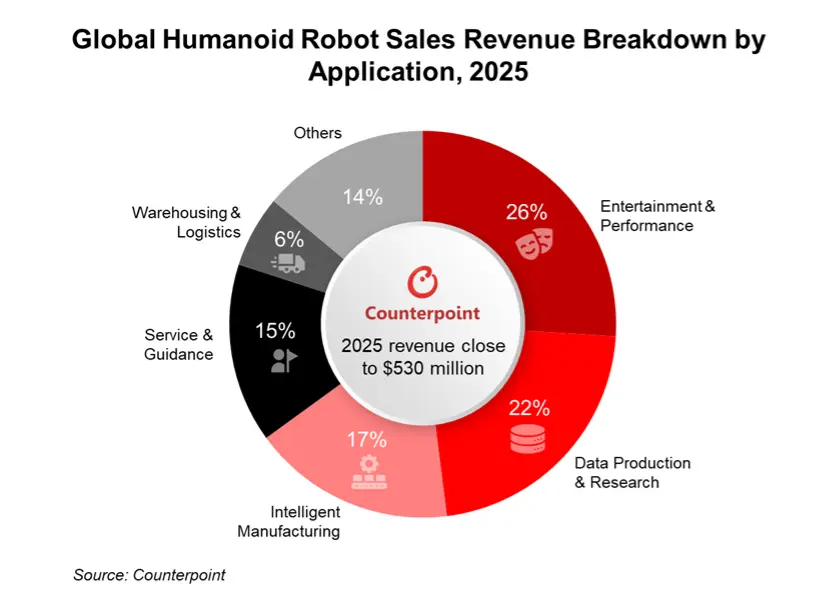
- Two major scenarios – entertainment and performance, and data production – contributed the most to humanoid robot sales revenue, accounting for 26% and 22%, respectively.
- Global revenue from humanoid robots is expected to reach $4.4 billion in 2027.
Commercial deployment of humanoid robots accelerated in 2025, with their global sales crossing the $500-million revenue mark for the first time. Among more than 300 humanoid robot enterprises worldwide, those from China have performed exceptionally well, serving as a key driving force for the industry to enter large-scale development.
1. AGIBOT, Unitree, UBTECH Lead Global Commercialization of Humanoid Robots
In 2025, a clear market concentration emerged at the top in terms of both sales revenue and shipment volume. According to Counterpoint Research’s Humanoid Robots Research, the top three enterprises accounted for nearly 56% of the global sales revenue.
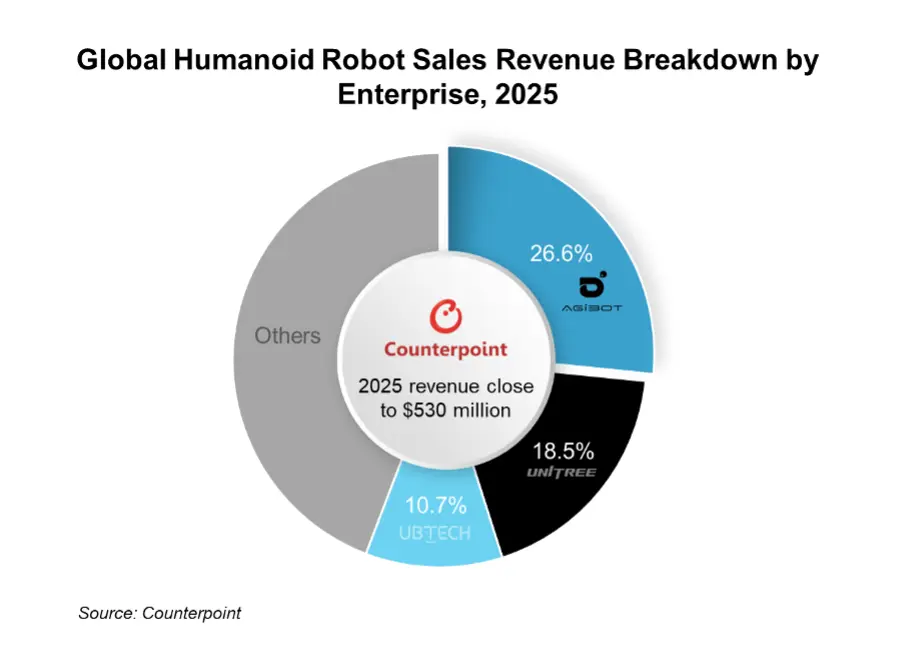
Based in Shanghai, AGIBOT achieved revenue of over $140 million in 2025, ranking first globally. It has made large-scale deployments and investments in multiple scenarios, including in entertainment and performance; services and guidance; data production; and intelligent manufacturing. Unitree from Hangzhou and UBTECH from Shenzhen ranked second and third, respectively, serving as representative enterprises of embodied intelligence innovations in their respective cities as well.
Having taken the lead and stood out in the global commercialization of humanoid robots, their key to success can be summarized as follows:
- Rich product portfolio and mass production capability
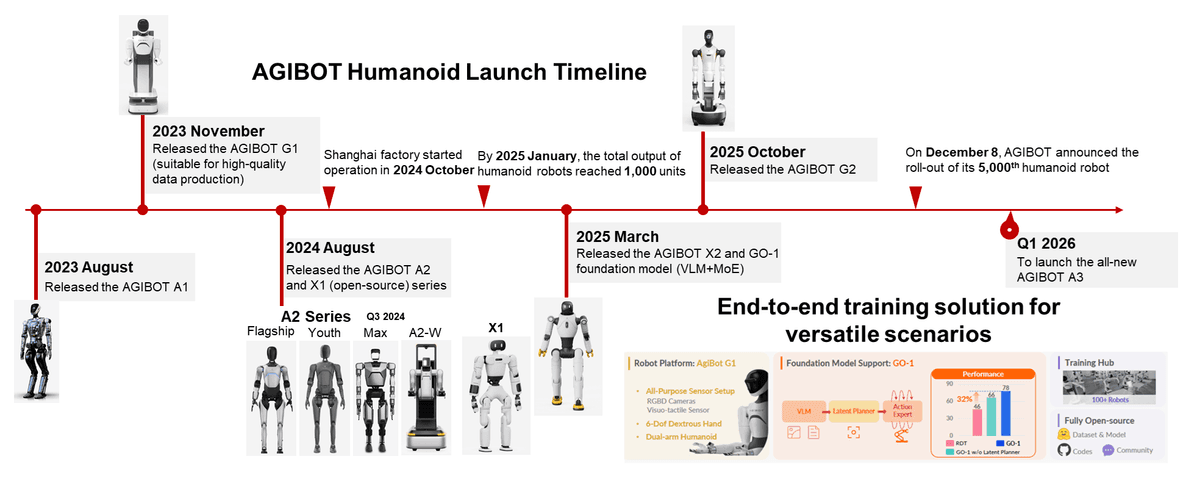
AGIBOT, Unitree and UBTECH all operate their own robot production facilities. In addition, all three have achieved full-stack independent research and development capabilities for dexterous hands. Taking AGIBOT as an example, since the launch of the AGIBOT A1 in August 2023, the company has formed three major product lines – A-Series, X-Series and G-Series. Among them, the A-Series boasts a complete product array to meet application requirements across various scenarios. Equipped with high computing power and a powerful vision system, the G-Series delivers outstanding performance in data production and research, service and guidance. With the support of WholeBodyVLA, the AGIBOT X2 features exceptional locomotion capabilities, making it highly suitable for entertainment and performance.
AGIBOT Humanoid Robot Portfolio and Roadmap
Source: Counterpoint Research
- Outstanding full-stack capabilities across software and hardware
Unitree has continuously strengthened its technological advantages in motion control, based on the G1 platform, Unitree further enhanced robot locomotion performance. Recently, Unitree also joined the open-source race for AI brain models.
AGIBOT is one of the few humanoid robot startups that take the realization of Physical AGI as their core strategy. It has built a full-dimensional technology ecosystem focusing on locomotion, interaction and operation. The LinkCraft platform enables zero code creation of performance content for humanoid robots, while the LinkSoul platform supports personalized customization of robot voice, character and behavior. As a one-stop robot operation development platform, the GenieStudio platform greatly lowers the development threshold and improves efficiency. Meanwhile, AGIBOT actively promotes open data initiatives. The AGIBOT World project, led by the company, has generated abundant high-quality real-world operation datasets, supporting cutting-edge exploration in embodied intelligence. At AGIBOT, R&D personnel account for more than 70% of the total employees, and over two-thirds of them are engaged in the development of the robot brain and cerebellum. Among the first-tier enterprises aiming at developing general-purpose humanoid robots, AGIBOT’s R&D investment in the robot brain and cerebellum stands out as industry-leading.
- Explore commercial opportunities for humanoid robots and accumulate deployment know-how
The leading Chinese humanoid robot enterprises are also at the forefront of forging new business models. The lack of high-quality real-world training data limits the generalization ability and scenario deployment of humanoid robots. AGIBOT insists on using real-world data to train and optimize its models, with its self-built data factory and an end-to-end solution covering the entire data production and management lifecycle. Against this backdrop, AGIBOT has developed massive high-quality datasets from its robots, becoming the pioneer of the emerging DaaS (Data as a Service) business model for humanoid robots.
Based on its G1-D wheeled dual-arm robot, Unitree has also built comprehensive data production and management service capabilities. The participation of more humanoid robot companies will help address the data bottleneck in the industry and foster a prosperous DaaS ecosystem.
AGIBOT is also an active promoter of the RaaS (Robot as a Service) business model. The BOTSHARE platform, invested in by AGIBOT, offers a rich product portfolio from different humanoid robot vendors for various applications. The RaaS model effectively tackles challenges such as high unit prices, fragmented demand and high maintenance thresholds, greatly lowering the barrier to adopting humanoid robots.
Through close collaboration with humanoid robot enterprises, the leasing platform can provide customized solutions and on-site support for diversified needs, accelerating the widespread application of humanoid robots in the entertainment and performance, service and guidance, and other segments, enabling more users to experience the innovation brought by humanoid robots.
Chinese humanoid robot enterprises are also setting their sights on the vast overseas market. AGIBOT, Unitree and UBTECH all participated in CES 2026 and became highlights of the event. Afterwards, UBTECH signed a humanoid robot service agreement with European aviation giant Airbus.
2. Diverse Trends in Humanoid Robot Applications
In 2025, the application of humanoid robots showed a diverse trend. Currently, entertainment and performance; data production; intelligent manufacturing; services and guidance; and warehousing and logistics represent the major deployment scenarios, and will remain so for the next one to two years.
According to Counterpoint Research’s Humanoid Robots Research, these sectors accounted for 26%, 22%, 17%, 15% and 6% of global humanoid robot sales revenue in 2025, respectively.
Entertainment and performance
Humanoid robots have appeared on the stage of China’s Spring Festival Gala for two consecutive years, greatly raising public attention. In 2025, entertainment and performance became the largest application scenario in revenue terms.
On the one hand, the performance capability of humanoid robots continues to improve with increasingly diverse themes, but on the other hand, with the development of locomotion and emotional interaction capabilities, the aim of robot performances is shifting from pure technical demonstrations to artistic presentations. This field is expected to remain a key focus for the commercial use of humanoid robots in 2026.
Data production and research
The scarcity of real-world training data for embodied AI models has driven demand for data production solutions. Going forward, data factories will continue to be a critical scenario for the commercial application acceleration of humanoid robots, supporting their large-scale deployment across various verticals. On this basis, the emerging DaaS business for humanoid robots is poised for rapid growth.
Intelligent manufacturing
Against the backdrop of intelligent industrial production and labor shortages, intelligent manufacturing represents an important scenario for the large-scale deployment of humanoid robots. After two years of on-site training and testing, 2026 will mark the first year of large-scale industrial deployment of humanoid robots. UBTECH’s humanoid robot Walker S2 has gained popularity among numerous manufacturing enterprises, with partners from automotive, consumer electronics, semiconductor manufacturing, traditional industry and other sectors, including Foxconn, Texas Instruments and Airbus.
Services and guidance
Chinese humanoid robot enterprises have actively explored the services and guidance sector, accumulating rich practical deployment know-how. Successful commercial cases have been achieved in unmanned retail, tourism, reception and exhibition hall interactions, with more scenarios continuing to be added, showing a flourishing application landscape. In the future, with a complete safety strategy for humanoid robots, the scale of applications in services and guidance will further expand, and Chinese enterprises will also enter overseas markets with their extensive experience.
Warehousing and logistics
Humanoid robots serve as a key supplement to achieving full automation in warehousing and logistics. Their value lies in filling the gap in flexible picking, a major bottleneck in modern logistics caused by small-batch, multi-SKU operations that require frequent process switching and handling of various exceptions. E-commerce and logistics enterprises, including Amazon, SF Express and GXO Logistics, have shown strong interest in large-scale adoption of humanoid robots.
Conclusion
At a critical moment when the humanoid robot industry is moving toward mass production, Chinese humanoid robot enterprises have demonstrated strong technological and commercial innovation capabilities and are leading the global commercialization progress. Global humanoid robot sales revenue will experience explosive growth in the coming years. Counterpoint Research forecasts that global hardware sales of humanoid robots will reach $2.9 billion in 2027, with corresponding service and software revenue reaching approximately $1.5 billion.


