

- 2026 is set to see a breakthrough in the expansion of robotaxi deployments, with Counterpoint forecasting that the robotaxi service market will grow to $168 billion by 2035 with a fleet size of 3.6 million.
- Zoox, as an independent robotaxi player, is currently forecasted to capture a smaller market share in the service market. However, this could change when Zoox reaches its full potential.
- Zoox has a unique proposition among robotaxi players – a purpose-built vehicle, in-house manufacturing, being able to pioneer and shape regulations and the potential to leverage Amazon’s Prime subscription ecosystem.
As the transportation industry moves to “fully self-driven” autonomous vehicles, Amazon-owned Zoox’s purpose-built vehicle truly sets the benchmark for what the future of mobility could look like. For far too long, car designs have been anchored to have a human driver as a key requirement. Automakers have spent decades perfecting the steering feel and required pedal effort, and turning the in-cabin experience, provided in part by the instrument cluster and infotainment system, into a critical selling factor. Zoox provides a window into what the driverless future looks like for car designs, but that’s not all the company’s efforts show. Zoox is also pushing the envelope on driverless vehicle regulations and the potential for a disruptive business model where robotaxis could truly replace car ownership.
Future Growth of Robotaxis
The robotaxi market is expected to see transformative growth through 2035, with the market value for services projected to reach $168 billion, according to Counterpoint Research’s comprehensive new Global Robotaxi Vehicle Sales and Services Market Forecast. This growth is underpinned by the rapid advancement in AI models that enable end-to-end autonomy, record investments, and rapidly expanding fleet sizes.
Global Robotaxi Fleet and Services Market Size
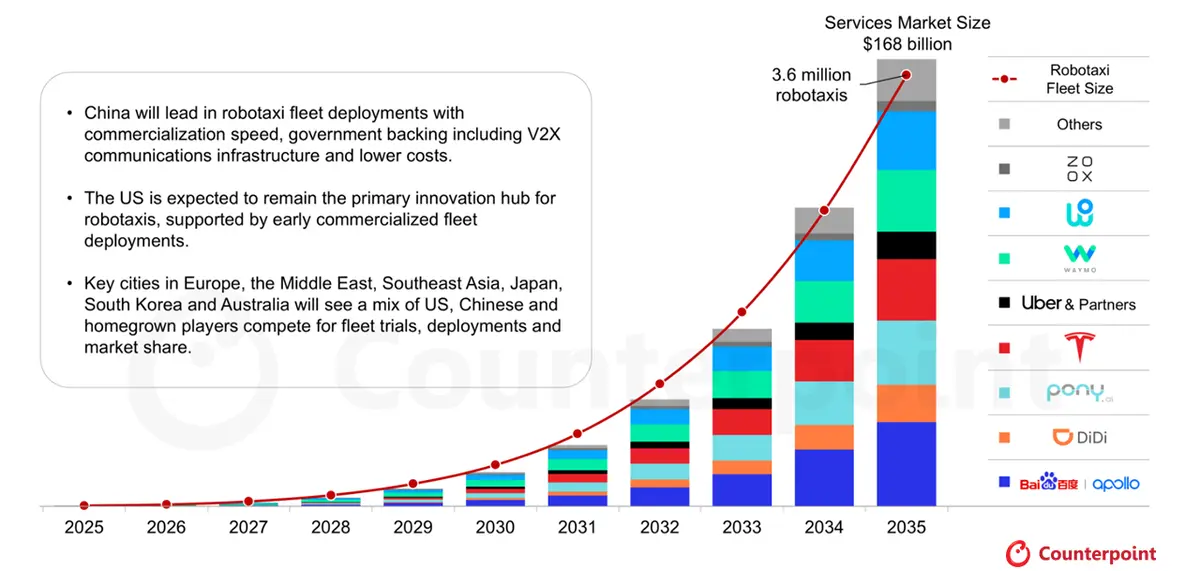
Source: Counterpoint Research Global Robotaxi Vehicle Sales and Service Market Forecast, April 2026
2026 is likely to be a critical inflection point for global expansion, as the robotaxi industry moves beyond localized pilot programs into large-scale commercialization. By 2035, Counterpoint Research expects the global robotaxi fleet to reach 3.6 million vehicles, fundamentally reshaping urban transit, and challenging the concept of vehicle ownership.
Zoox has currently deployed its fleets in San Francisco and Las Vegas and is testing its autonomous technology in 10 US cities, although its market size and fleet size growth in the forecast are comparatively smaller. By comparison, Counterpoint Research expects early movers such as Waymo, Baidu Apollo Go, Tesla, WeRide and Pony.ai to capitalise on their growth through rapidly scaling their operations across North America, China and other countries in Asia, and key cities in Europe. However, the foundation that Zoox is laying could change the course of the autonomous rides business and vehicle ownership. Additionally, what is currently Zoox’s limiting factor may in the future propel its growth and economics.
Innovative and Unconventional Approach in Design
Zoox’s vehicle does not look like a car because it does not function like one. It is built on its own unique platform and that offers significant advantages and differentiation when compared to the conventional passenger cars which other robotaxi operators use.
The vehicle is symmetrical and does not have a "front" or "back." This means that the vehicle can be driven in both directions. Imagine the versatility of a Zoox vehicle in a narrow urban alleyway or on a medieval road in Europe where it does not need to perform a 3-point turn and can simply reverse its direction of travel and carry on.
Four-wheel steering allows the vehicle to "crab" (by rotating its wheels) into tight parking spots or navigate the hairpin turns of San Francisco’s Lombard Street with a turning radius that would make a subcompact car jealous. While this is not the first implementation of the “crab mode”, it is the most purposeful. Especially with the wheels at the extreme four corners, the Zoox provides unrivalled maneuverability when space is tight.
Zoox Robotaxi Initial Sketches and Design Advantages
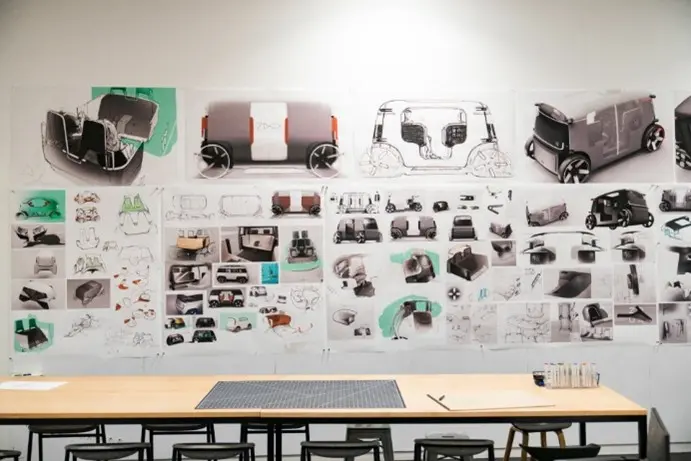
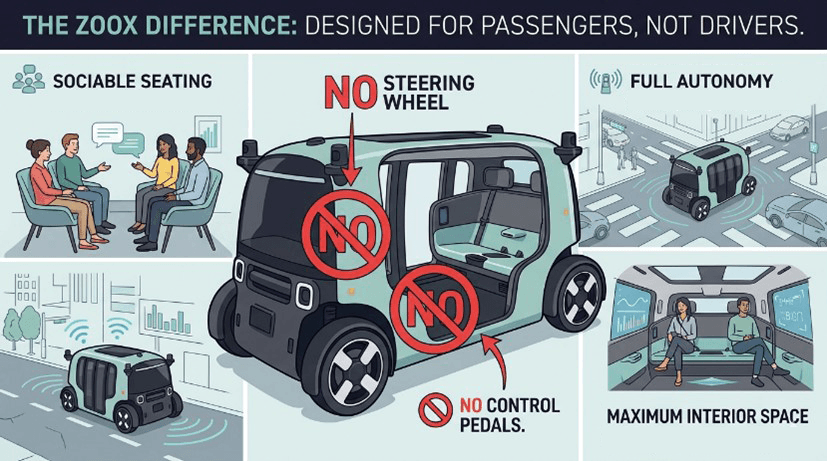
Sources: Car Design News, Google Gemini, Zoox
The unconventional theme carries on inside, where passengers face each other when seated. The author has travelled in a Zoox robotaxi while attending CES 2026 in Las Vegas and can attest to the transformation of a regular commute into a social space, especially when travelling as a group. The legroom when seated is enormous, and it could easily accommodate a couple of large bags if you were commuting to or from an airport. One negative, however, was getting in and out. As you climb in or out of the seat, you need to duck as there is not enough headroom to stand, but this is only a momentary inconvenience until you are seated.
Watch: Zoox Autonomous Robotaxi: Purpose Built for the Future vs Rival Waymo's Adopted Passenger Car
Amazon Prime-led Potential for Business Case Disruption
When Amazon acquired Zoox in 2020, many industry analysts wondered if Amazon intended to convert Zoox’s focus from passenger transportation to last-mile delivery to support its Prime subscription. Although that speculation has not materialized, Zoox’s deployments, combined with the vehicle’s design, open the door to a much broader range of use cases –Transportation as a Service (TaaS) which perhaps in future could be integrated into the Prime subscription ecosystem.
Like its highly efficient Amazon warehouse operations, Zoox could operate at high utilization rates through efficient routing, ridesharing and commuter route transportation. Further, the passenger transportation services that Zoox provides is hugely cyclical on a daily basis, with peak hours for travel where the company operates. Robotaxi economics depends on what it can charge per mile or kilometer when it carries passengers. When demand is high, this model enables robotaxi companies to get high margin returns. During periods of low demand, low utilization reduces margins significantly. However, if Zoox can employ its vehicles to provide last-mile delivery services (with modular, removable seats) during off-peak times, it can greatly help improve utilization rates, providing not just additional revenue but also enabling the company to maintain healthy margin pricing for passenger transportation during that time period. This low operating and high margin model can provide Zoox the best business case among peer robotaxi companies.
This could be a significant differentiator when compared to other robotaxi firms that mainly target the replacement of taxi/ rideshare services like Uber and Lyft. Increasing utilization through package delivery will reduce the cost per mile. Additionally, plugging Zoox’s service into the monthly Amazon Prime subscription, for example through commuter credits, would further improve customer retention for Amazon Prime subscriptions.
Zoox Autonomous Rides as part of Amazon Prime Subscriptions?
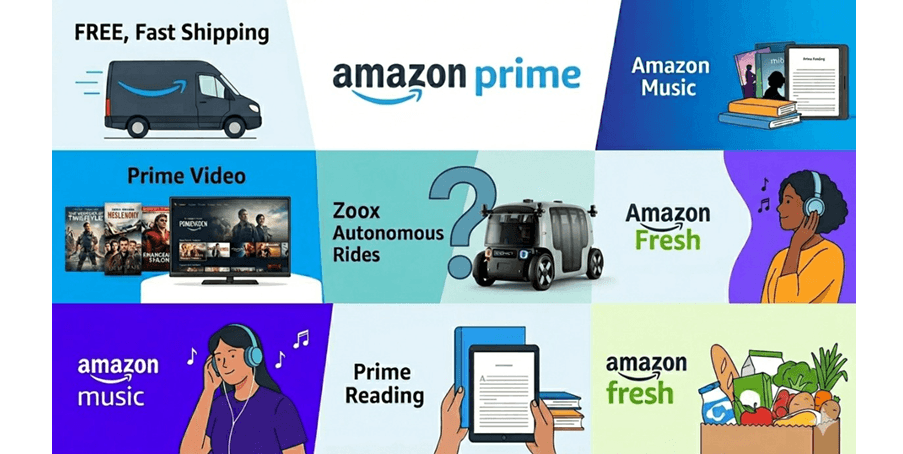
Sources: Google Gemini, Counterpoint Research
While Zoox’s primary purpose is passenger transport and logistics, in-vehicle shopping and consumption of infotainment by passengers can provide even more stickiness for the Amazon Prime subscription as well as boost revenues, especially from shopping, enabling a business model moat that other robotaxi firms may find hard to emulate and compete with. The key for Zoox will be balancing the costs of additional hardware, such as an infotainment system, with the revenue opportunity from these other Amazon services.
Manufacturing – A High Risk, High Reward Opportunity
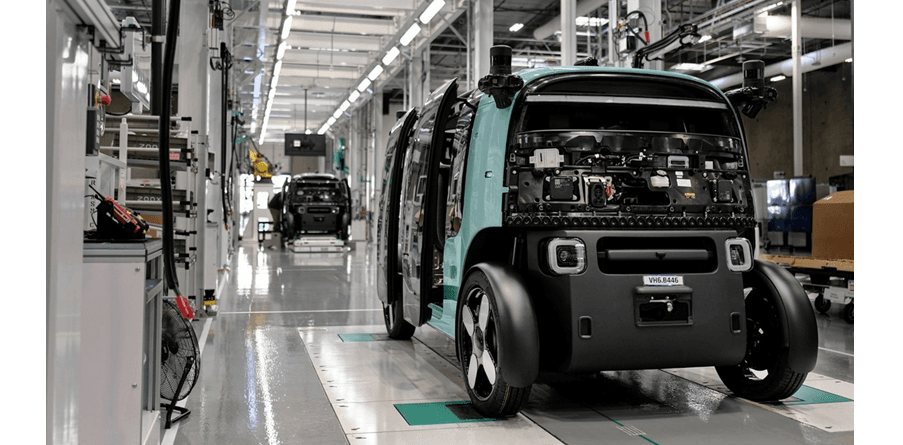
Zoox’s ground-up design means it could develop its vehicle to be modular and scalable, for example using a simplified box design. Zoox is the first Level 4 vehicle in operation without driver controls, such as a steering wheel, pedals, instrument cluster and gear shifter. This means fewer parts, which makes assembling the pod that much easier. The vehicle being symmetrical in design means components such as seats, doors, windows, head and taillights are reused. So, despite the company’s lower manufacturing capacity of 10,000 vehicles per annum, the systems and components achieve improved economies of scale.
Zoox Vehicle Manufacturing Assembly Line – Hayward, California
Source: Zoox
Having a bespoke design certainly has its advantages of control and vertical integration, though it is not without its own risks. Zoox has already made a high capital investment in developing the base vehicle, over and above the investment in the technologies to enable autonomous driving capabilities. The company’s opportunities to perform real-world testing and validation of vehicle systems and components have also been limited due to the small number of operating zones for Zoox. This limits, for instance, the mileage accumulation for body and chassis development, and means a lack of extreme hot and cold climate testing in Nevada or the Arctics, as well as durability testing of key systems and components including battery aging tests in the real world.
Ultimately, though the vehicle has high potential for multi-purpose use as a people and goods carrier, the integration of Amazon’s ecosystem in the cabin and the opportunities this provides is one of the key competitive advantages for Zoox. Its independence from external OEM partners for vehicle supply, and the lack of a need to retrofit autonomous vehicle systems and components onto a base vehicle, gives Zoox ultimate control of its destiny and approach.
Pioneering the Regulatory Path
One of the most significant hurdles for autonomous vehicles is regulations. Historically, in the US market, regulators wrote the Federal Motor Vehicle Safety Standards (FMVSS) with the assumption that every car would have a steering wheel, a brake pedal, and a driver’s seat. Zoox has worked to redefine these regulations having sought FMVSS exemptions from eight federal safety standards written for vehicles designed to be driven by humans. The exemptions for Zoox would be from standards that require a vehicle to have windshield defrosting and defogging systems, windshield wiping and washing systems, lamps, rear visibility, conventional brake pedal and some occupant crash protection equipment like exterior mirrors, light controls (which occupants can manipulate causing unwanted risk)t, arguing its vehicles meet or exceed equivalent safety levels.
If regulators grant these exemptions to Zoox (initially limited to 2,500 vehicles), that will pave the way for the broader adoption of autonomous vehicles with steering‑wheel‑free designs, prompting other automakers to file similar requests and accelerating their commercialization. For Zoox, the exemptions will help the company speed up its expansion and scaling, which currently lag behind rivals like Waymo.
Analyst Take
- Zoox’s bidirectional, four-wheel steering architecture, combined with a carriage-style interior that prioritizes rider comfort and social seating, positions Zoox as the only robotaxi player focusing on the future manifestation of urban transit. This gives it not just a novelty factor that may appeal to riders but also offers practicality. Furthermore, the design of the vehicles is simplified with cost reduction coming from no in-cabin steering and control pedals, along with the reuse of major body structures, windows and doors. This provides a significant improvement to economies of scale even for limited production scaling up to 10,000 units per annum.
- Zoox has partnered with Uber to offer services in Las Vegas starting this summer to drive demand. This will enable Zoox to focus entirely on hardware and autonomous technology optimization without operational headaches. Long-term, we can expect Zoox to evolve into a "Prime Transport" subscription, where the Amazon flywheel locks in users with a seamless blend of logistics, entertainment, and autonomous mobility.
- By controlling the entire hardware stack rather than outsourcing it to passenger vehicle OEMs, Zoox is uniquely positioned to take charge of its own destiny and propel its growth. While Zoox’s intelligent vehicle design provides economies of scale in manufacturing, and its Amazon Prime ecosystem offers a potential captive subscription model, the company’s pioneering of regulatory changes and leveraging of Amazon’s logistics’ laser-like focus on cost-per-mile optimization can provide it with the real lead. Whether or not this synergistic advantage materializes depends a lot on proving out its technology in the near and medium term, the success of its operations and most importantly acceptance by consumers.
