- eSA shifts eSIM security from component-level validation to system-level assurance, addressing growing risks in large-scale IoT and Edge AI deployments.
- SGP.32 architectures, with eIM and IPAe, enable orchestration-led connectivity, but real-world security outcomes depend on how these capabilities are implemented, not just certified.
- Regulations such as the EU Cyber Resilience Act are making security patching and lifecycle accountability mandatory, positioning eSA-aligned implementations as critical for market access.
The rapid expansion of IoT deployments is bringing security vulnerabilities into sharper focus. Many IoT devices operate in distributed, unattended environments with long lifecycles, making them susceptible to risks such as unauthorized access, firmware tampering, and insecure provisioning. Unlike consumer devices, these endpoints often lack regular physical oversight, increasing the importance of secure remote management.
This challenge is becoming more pronounced with the rise of Edge AI, where intelligence is embedded directly into devices at the network edge. These deployments require not only reliable connectivity but also continuous trust, secure updates, and operational control across large device fleets. Regulatory frameworks such as the EU Cyber Resilience Act are introducing explicit requirements around vulnerability management and security patching across both IoT and consumer devices, including those distributed through open market channels. With convergence across frameworks such as NIST 2 and EO 14028, these requirements are moving from guidance to near-term enforcement.
The GSMA’s eUICC Security Assurance (eSA) scheme provides a standardized framework to validate the security of eSIM implementations. It evaluates the entire eSIM stack, including hardware, operating system, and provisioning infrastructure, marking a shift from component level validation toward a more integrated, system-level assurance model.
eSA aligns closely with emerging IoT specifications such as SGP.32, which introduce a more scalable architecture for remote SIM provisioning. Within this framework, components such as the eIM and IPAe enable remote orchestration and on-device profile handling. As deployments scale across regions and operators, ensuring these components remain secure and interoperable becomes critical, particularly as enterprises look to decouple connectivity management from traditional operator-led models.
From Positioning to Secure Orchestration in eSIM
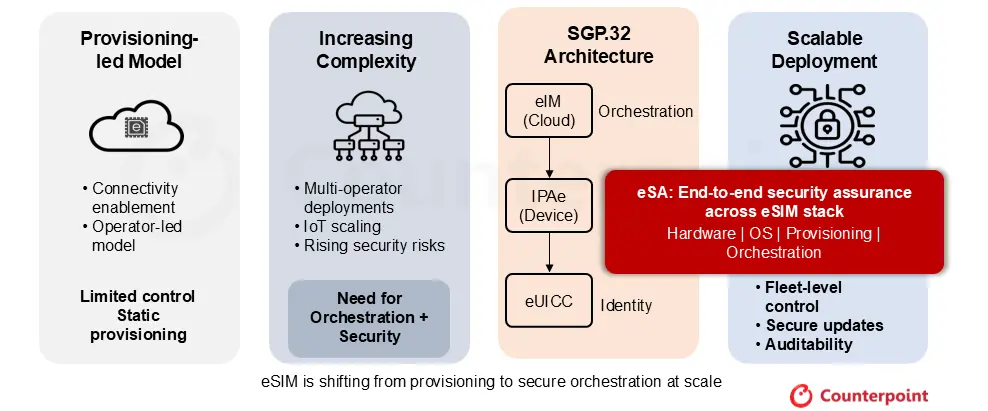
Source: Counterpoint Research
However, certification alone does not guarantee alignment with emerging regulatory requirements. While eSA and SAS provide a foundation for security assurance, outcomes depend on how SGP.32 architectures are implemented in practice. Several capabilities within the specification, including indirect profile download and resilient update mechanisms enabled through IPAe, are defined as optional. In practice, these features become essential to ensure reliable security patching, particularly where devices may be intermittently connected or unreachable.
Key Industry Shifts Driving eSA Relevance
- Security as an Operational Bottleneck
Managing device fleets at scale remains complex, including enforcing policies, enabling secure updates, and maintaining auditability. eSA helps establish trust across these operational layers. - Shift Toward SGP.32-based Architectures
SGP.32 reflects a move toward cloud-driven, orchestration-centric models. The introduction of eIM and IPAe improves flexibility while increasing the need for standardized security validation. - Regulation and Market Access Alignment
Frameworks such as the EU Cyber Resilience Act are driving lifecycle accountability, with certifications increasingly becoming prerequisites for regulated markets.
eSIM/iSIM security-enabled IoT solutions provider Kigen’s recent eSA certification reflects how vendors are aligning with these evolving requirements, while also highlighting a more implementation-driven approach to security and compliance. Unlike traditional approaches that treat consumer and IoT eSIM implementations separately, UK-based Kigen is working toward a unified stack across SGP.22 and SGP.32, reducing fragmentation for OEMs and enterprises.
Its approach extends beyond certification and toward enabling deployments aligned with regulatory expectations, including the implementation of key SGP.32 capabilities that support reliable security patching in real-world conditions. This positions Kigen to address both certification requirements such as eSA and the practical challenges of delivering cyber resilient IoT deployments across distributed environments.
The next phase of eSIM adoption will be defined not by provisioning scale, but by the ability to operationalize secure, resilient, and regulation-ready connectivity across increasingly complex and distributed IoT environments. eSA certification is an early signal of this shift, with SGP.32-based architectures expected to play a central role in enabling it.


