

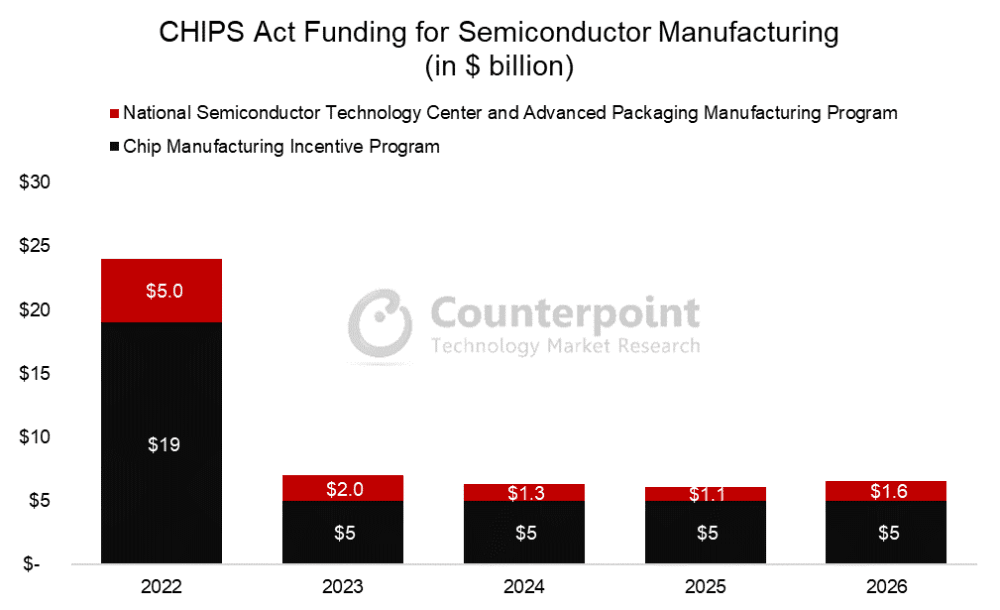
- The legislation includes over $52 billion in subsidies for semiconductor manufacturing.
- So far, investments worth over $200 billion have been announced for manufacturing.
- New foundries from TSMC, Intel, Samsung, Micron and Texas Instruments are underway.
Last August, the US Congress passed the CHIPS Act, the largest piece of industrial policy signed into law in the US in a generation. The legislation includes over $52 billion in subsidies for semiconductor chip manufacturing. Over the past two decades, the share of semiconductors manufactured in the US has steadily fallen while advanced semiconductor chip manufacturing has become increasingly concentrated in just a handful of cities, primarily in Taiwan and South Korea.
The outbreak of COVID-19 wreaked havoc on supply chains as factories shuttered, while the fallout of an unexpected winter storm in Texas further disrupted semiconductor chip manufacturing. Compounded by an explosion of demand as companies, schools and government offices pivoted to work from home, the chip shortage set in, shaving a percentage off of GDP growth according to the White House. In summary, the events of the past few years have made abundantly clear the foundational role that semiconductors play in today’s economy, and the costs that accompany constrained supply.
 From United States Public Law 117-167 – Aug. 9, 2022
All this triggered the finalization and passage of the CHIPS Act. The US government was convinced that the country’s supply of semiconductors, which power everything from washing machines, smartphones and cars to supercomputers and hypersonic missiles, faced an unacceptable bottleneck at a pivotal moment. The US is almost entirely dependent on Taiwan for the production of advanced chips even as cross-strait tensions reach new highs and US-China relations new lows. Indeed, concerns over a potential conflict in the South China Sea as well as between North Korea and South Korea, not to mention acts of God, impacting chip supplies convinced the US government about boosting the country’s semiconductor chip manufacturing. But with higher labor costs and plenty of red tape, semiconductor manufacturers needed added incentives to make the transition worthwhile. The CHIPS Act has done just that, sparking a wave of private investment.
Since the CHIPS Act was passed, investments worth over $200 billion have been announced for manufacturing capacity in the US, with new foundries underway from TSMC, Intel, Samsung, Micron and Texas Instruments. But while the CHIPS Act has lit the flame under private companies to act, some of the legislation’s provisions and shortcomings could lead to its undoing. These projects are faced with red tape and regulations that will cause them to linger before coming on line. Besides, while funding has been made available for workforce education and job training, the scale of the need for new employees and the lack of the required workers and skills will likely pain semiconductor firms for years to come. One solution would be to raise the number of visas available for skilled workers from abroad. Another would be to provide targeted assistance to students pursuing degrees in related fields. Finally, the Act itself fails to address the reason why semiconductor chip manufacturing left the US in the first place – American labor costs and regulations make production in the US more expensive than elsewhere. Once the funding runs dry, how will American semiconductor chip manufacturing remain competitive? Additional burdens on employers to guarantee union wages and provide child care certainly won’t make these projects anymore cost-competitive.
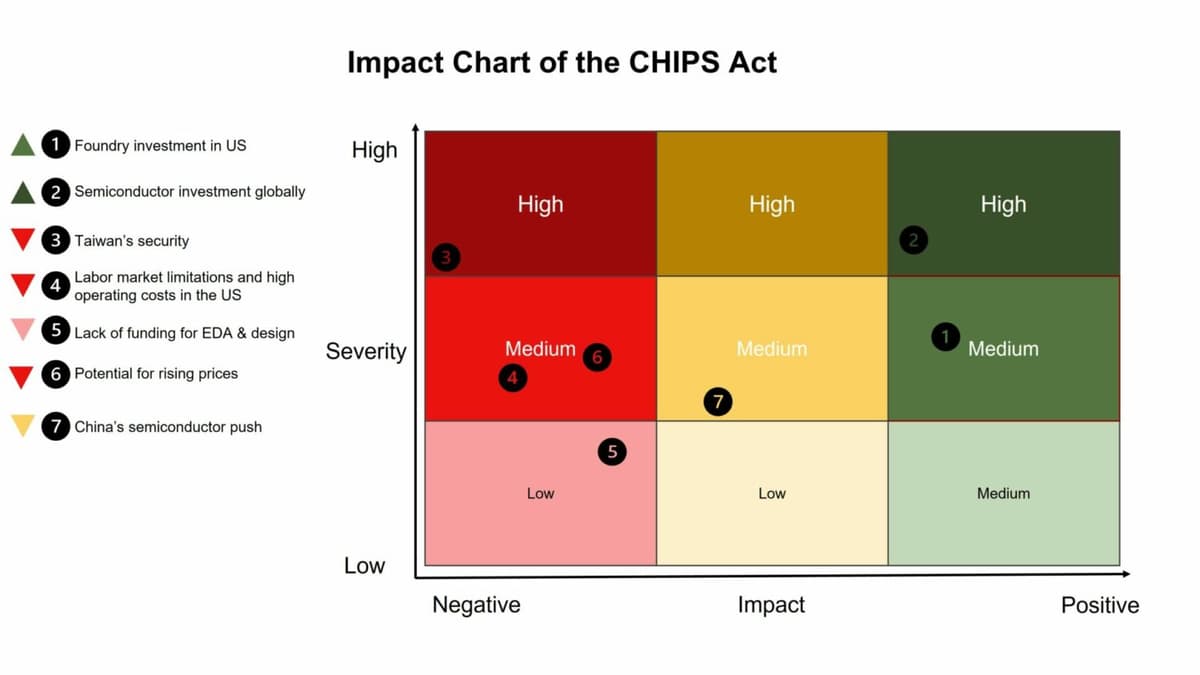 While flawed, the CHIPS Act is a major stepping stone to creating secure, resilient supply chains that will insulate the country from many outside shocks. This is a step in the right direction, but more must be done if the country wants to win the semiconductor manufacturing marathon and avoid fizzling out after the starting sprint.
For more information about the CHIPS Act, a detailed report on the legislation can be found here.
Additional Reading:
US Chips Act Takes New Form Before August Recess, Leaves Some Unhappy
UMC Q1 2023 Earnings: Weak Cyclical Recovery But 28nm Remains Resilient
Global Smartphone AP (Application Processor) Shipments Market Share: Q3 2021 to Q4 2022
Will Japan Curbs Hit China Semiconductor Self-reliance Plans?


