- The three pivot areas on which Tesla is focusing its future – autonomous vehicles, robotaxis and robotics – show tremendous growth potential, according to Counterpoint Research forecasts.
- Tesla faces a few significant challenges pertaining to wide-scale availability of hardware, technology prove-out and backward compatibility of software with existing cars as well as regulatory hurdles.
- Resolving these issues will require investing high amounts of capital and resources as well as lobbying with regulators with the short-term implication of delays to revenue realization from the three foresaid high-potential pivots.
The dust has settled on the frantic of tracking, reviewing, commenting and forecasting for Tesla, a ritual that the markets are habituated to and perform religiously every quarter during the week of Tesla’s quarterly earnings update. Last week was no different, and a lot has been said about Tesla’s pivots from electric vehicles to an autonomous robotics company focused on autonomous cars, robotaxis and humanoid robots. At Counterpoint Research, we track the global advanced driver assistance systems (ADAS) and autonomous driving markets and technologies, robotaxis and robotics. Based on this coverage, we are adding to some key perspectives less covered for Tesla.
What Do the Market and Technology Trends Tell Us?
Before jumping into our perspective on Tesla, we lay out our view on the three key pivots that Tesla is focusing on and betting its future upon.
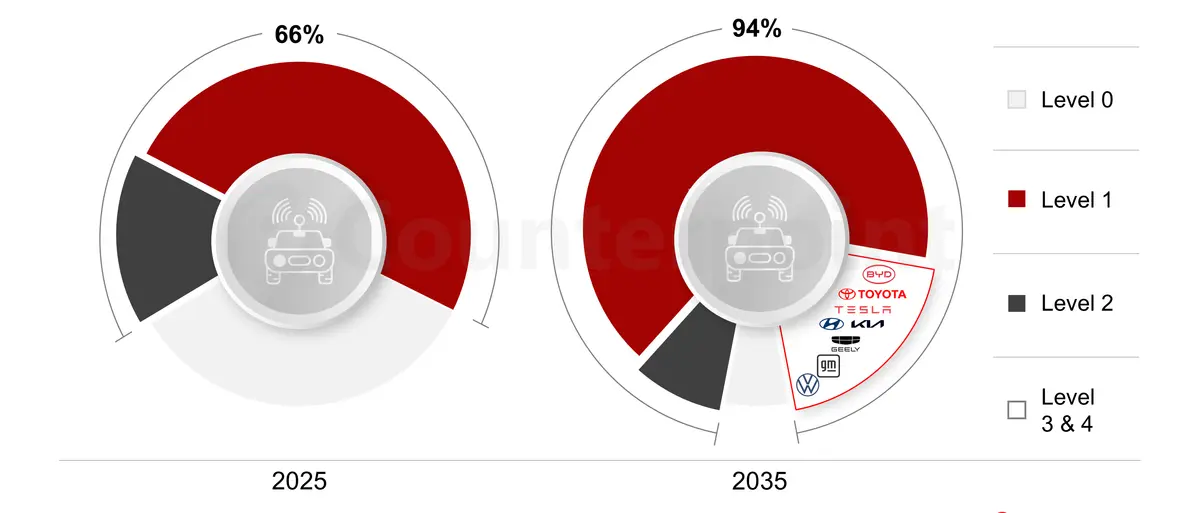
The global penetration of ADAS and autonomous vehicles is expected to grow to 94% by 2035 from 66% in 2025, with the penetration of Level 3 and Level 4 systems increasing to 20% by 2035, according to Counterpoint Research’s Global ADAS and Autonomous Vehicle Forecast.
Global ADAS and Autonomous Vehicle Sales Forecast by SAE Level
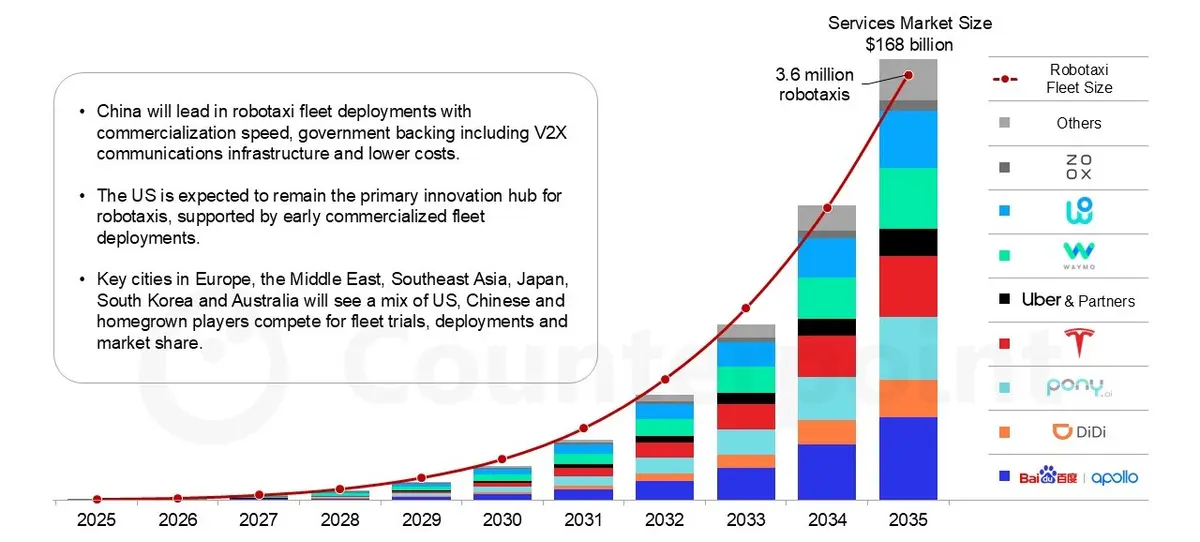
Counterpoint Research forecasts the robotaxi market will see transformative growth through 2035, with the market value for services projected to reach $168 billion, according to our comprehensive new Global Robotaxi Vehicle Sales and Services Market Forecast. 2026 is likely to be a critical inflection point for global expansion, as the robotaxi industry moves beyond localized pilot programs to large-scale commercialization. By 2035, Counterpoint Research expects the global robotaxi fleet to reach 3.6 million vehicles, fundamentally reshaping urban transit, and challenging the concept of vehicle ownership. For Tesla, the market opportunity is clear, but the company is not the only one in the race.
Global Robotaxi Fleet and Services Market Size
As another focus area for Tesla, the humanoid robot market is emerging. While still in the early stages of development, humanoid robots are gaining momentum as companies develop machines capable of performing complex human-like tasks across factories, warehouses and service environments. Counterpoint Research expects the humanoid robot segment to be the fastest-growing category in terms of shipments, with cumulative installations of humanoid robots projected to exceed 100,000 units by 2028, growing 7x compared to 2025. Driven by scaling from industrial automation and humanoid robots, Counterpoint Research’s Global Physical AI Market Tracker projects 48 million units of robots will have been shipped by 2035.
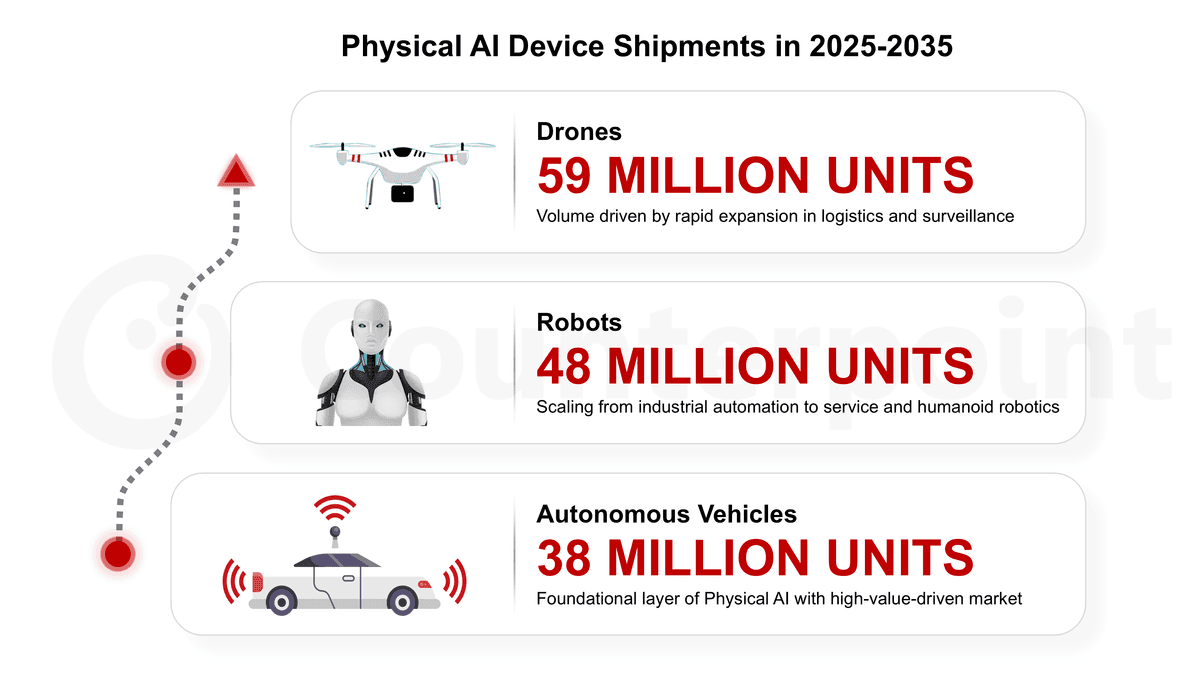
Tesla’s future bet sits within the above three promising and significant growth market paradigms of autonomous vehicles (Full Self Driving – FSD), robotaxis (Cybercab) and robotics (Optimus). Therefore, it is important to review how Tesla is progressing across these frontiers and when it is likely that the promises Tesla has made will convert to revenue.
Tesla’s Autonomy Progress Looks Messy in the Rear View Mirror
Tesla’s “Services and Others” category accounted for 16.5%, or $3.7 billion, of its total revenue of $22.4 billion in Q1 2026, growing by 42% YoY. This service revenue growth came on the back of Tesla’s move to charge a subscription fee of $99/month (instead of a one-off fee of $8,000) for the FSD option in its cars and earnings from supercharger usage. FSD subscriptions grew 51% YoY to reach 1.28 million. On the surface, this represents a great future opportunity, as Tesla has an estimated 9 million vehicles on road and growing. However, it is important to focus on two aspects of Tesla’s business:
- Subscription Growth: Tesla’s FSD (Supervised) subscription is currently available in Canada, the US, Mexico, Australia, New Zealand, South Korea and the Netherlands (from April 2026). Tesla has about 4 million vehicles on the road in these countries. Thus, the 1.28 million FSD subscriptions equal a 32% penetration rate on a 4 million vehicle base. This compares reasonably well with other known assisted driving subscription adoption rates of 40% for Super Cruise by GM and BlueCruise by Ford. FSD subscription growth in existing markets where it is permitted may therefore be limited, especially since there are millions of vehicles that have already paid for lifetime FSD, ranging from $8,000 to $15,000. China and Europe would be the next growth story for FSD subscriptions, though this depends on when the company gains regulatory approval. Overall, the growth of FSD subscriptions over the long-term will depend on Tesla maintaining momentum for sales of its electric vehicles, which has stagnated over the past 12-18 months.
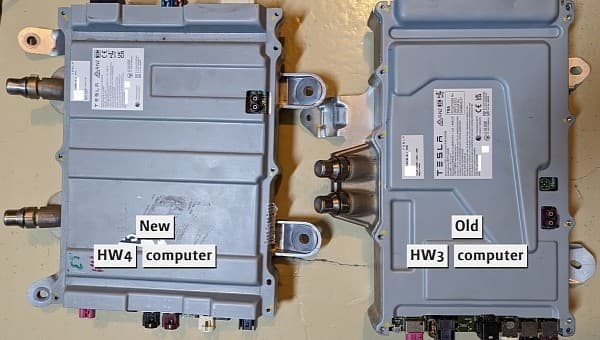
Tesla HW4 and HW3. Source: greentheonly/X - Backwards Compatibility of Software: The other limiting factor for Tesla’s plan for Unsupervised FSD is its ability to not only prove that the technology works but its big admission during the earnings call of hardware compatibility to roll out higher versions of FSD software. Tesla stated that the HW3 components currently installed in vehicles are not compatible with delivering Unsupervised FSD. During the call, Musk proposed two options the company is considering for existing owners. The first is to offer discounted trade-in for existing cars in exchange for a HW4 (AI4 chip) equipped vehicle or to set-up what Tesla calls “micro-factories” in cities and offer free retro fitment of HW4 in existing HW3 equipped vehicles that have paid the one-time cost for the FSD option. Tesla also promised a v14 FSD for HW3-equipped vehicles so it can keep providing FSD updates. The cost for Option A or B is further expected to divert capital and resources, which otherwise would support the rollout of Unsupervised FSD.
Slow Progress – Robotaxi Rollouts Delayed?
Tesla made ripples when it announced its vision to capture the robotaxi market in October 2024 with a purpose-built vehicle, the Cybercab, and its promise to dominate this segment like no other. In July 2025, Elon Musk said, “I believe half of the population of the US will be covered by Tesla’s robotaxi by the end of the year.” As of Q1 2026, we have seen robotaxi deployment in two cities – Austin and San Francisco – with the number of deployed Tesla vehicles still being very small. In April 2026, Tesla announced the expansion of its robotaxis to two more cities, Houston and Dallas. This contrasts with the company’s previous statements regarding growth, where it had planned to expand to seven new cities by H1 2026. Further, its expansion to two new cities consists of a limited number of cars and with restricted operational hours. Tesla, during its most recent earnings call, yet again announced a new target to expand to 12 new states. The two key challenges on the robotaxi front for Tesla are:
- Proven Technology: The robotaxi business requires autonomous vehicle technology to be proven and validated. To do this, next generation AI-chips are required for simulation and training purposes. Tesla requires a capital investment of $25 billion in FY2026 to set up its Terafab to manufacture its own AI chips. Apart from the high investment required, AI chip production is unlikely to provide enough volume before 2027, which will delay Tesla’s rollout of robotaxis and related revenue generation. In fact, Musk stated that Tesla’s robotaxi business will “likely will not see material revenue until at least 2027.” Apart from the chip, another validation point for Tesla is the vision-only path to autonomy. On the earnings call, Ashok Elluswamy, VP of AI at Tesla, said, “If the camera is not able to see things clearly because of residue build-up or what have you, then the FSD won't be available for those cars.” This may, to the skeptics, point to a need for a full, comprehensive sensor suite (including radar and LiDAR in addition to cameras) to provide necessary redundancy for exactly such a situation. Musk, too, on the call, emphasized – “The limiting factor for expansion is really rigorous validation, making sure things are completely safe. We don't want to have a single accidental injury with the expansion of Robotaxi.”
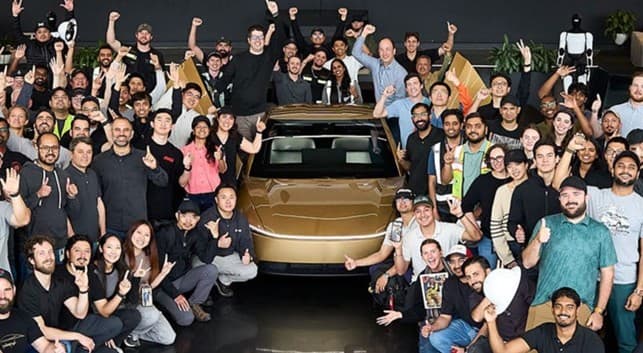
Commencement of Tesla Cybercab at Giga Texas. Source: Tesla - Cybercab Manufacturing: Tesla kicked off its Cybercab production in February 2026. The key aspect of the Cybercab, apart from being a two-seat vehicle, is that it does not have conventional steering and control pedals (accelerator and brakes). Historically, in the US market, Federal Motor Vehicle Safety Standards (FMVSS) regulations are based on every car having a steering wheel, a brake pedal, and a driver’s seat. Zoox, Amazon’s robotaxi autonomous vehicle company, has worked to redefine these regulations and sought FMVSS exemptions which are expected to be granted to a maximum of 2,500 vehicles per year. While this is a positive step that will pave way toward robotaxis without a steering wheel and control pedals like the Cybercab, the exemption limit of 2,500 vehicles, and the slow pace of granting the exemptions, can yet derail Tesla’s ambitious targets for Cybercab rollout. Here, the assumption is not that the regulators will block Tesla’s progress, but a more pragmatic concern that Tesla’s timelines for generating revenue from its robotaxi business will continue to lengthen. Meanwhile, competitors like Waymo, the Alphabet-owned robotaxi company, continue to scale in the US. The company plans to expand to overseas markets, too, with robotaxi deployments slated for London and Tokyo later in 2026. This has already made Waymo the foremost Western robotaxi player with the largest deployed fleet, accumulated commercial ride miles and an enviable safety record.
Robotics – Humanoids Scaling Challenge
A significant proportion of Tesla’s valuation is based on optimism that its planned robotaxi operations will generate significant revenue and on the success of its Optimus humanoid robots. The evidence for this is the resilience of Tesla’s stock price despite the company having reported its first decline in revenue in 2025.
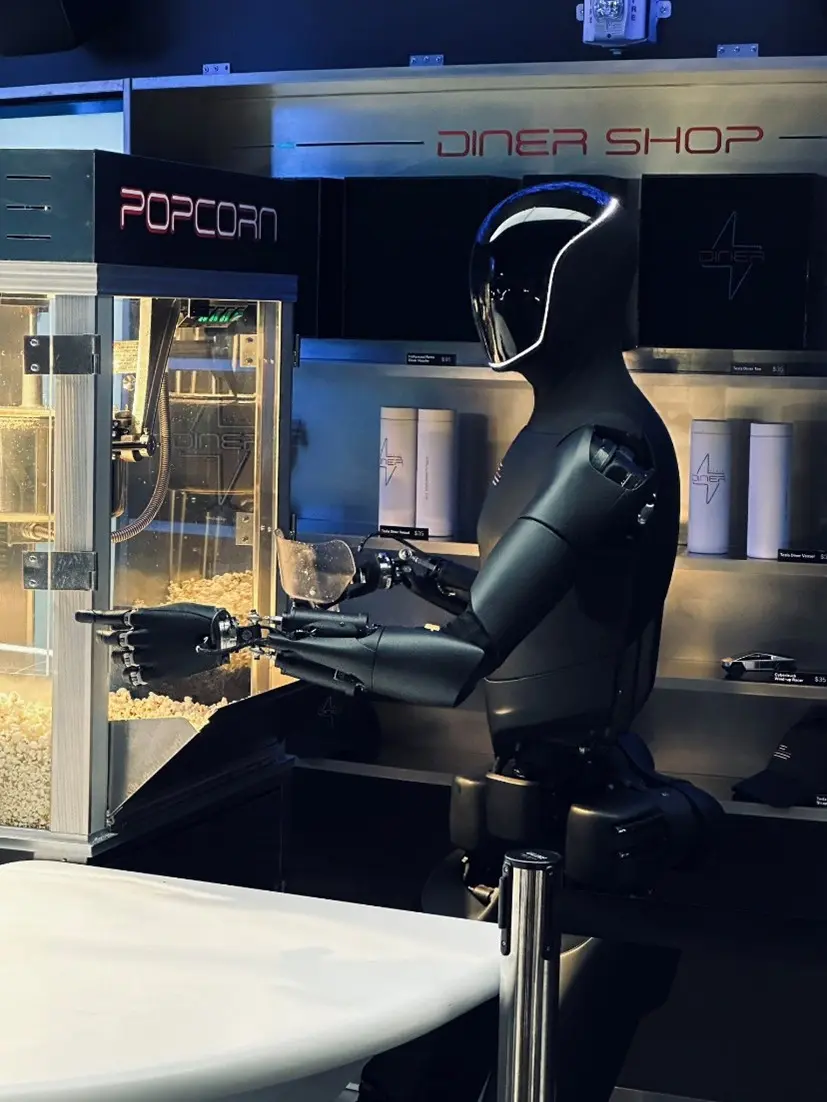
If robotaxis and AI chip production end up facing multi-year delays, they will directly impact on the rollout plans for the Optimus humanoid robot. This is because the company is developing the Optimus robot using the same hardware and software platform that it is developing robotaxis on. The company uses the same AI infrastructure for training and development for both programs. Furthermore, both Cybercab and Optimus robot manufacturing are set to be co-located at the same factory at Giga Texas.
Analyst Take
- Tesla’s autonomous vehicle push for private buyers and for robotaxis is facing a significant predicament linked to the rollout of its AI chips. For the company to develop and validate unsupervised FSD, AI5 chips will be essential, which currently are out of sync and not meant to be made before 2027, thus causing potential delays in realizing FSD subscription and robotaxi-linked revenue.
- To avoid a legal challenge arising from the promise made to millions of one-time payers of full unsupervised FSD users, Tesla will need to take a further hit in an expensive buyback and exchange scheme for HW3 equipped cars or undertake a logistical and resource-heavy challenge of retrofitting the HW4 chip to existing HW3-equipped vehicles.
- Residue buildup on vehicle cameras will lead to non-availability/disengagement of FSD, which is okay for supervised FSD but will not work for unsupervised FSD. The question is whether Tesla will bite the bullet and add additional sensors like Radar and LiDAR to its Cybercab and HW4-equipped cars capable of unsupervised FSD. We believe if regulators cannot be satisfied, this course of action will become essential, further adding to costs for Tesla.
- Lastly, the current exemption from regulations may become a bottleneck for widescale rollout of unsupervised FSD and robotaxis by Tesla. Self-certification by Tesla is mentioned as one way around this, but this will get tested closer to the launch whether Tesla has been able to convince the regulator.
- Looking at its history, there is no doubt that Tesla has the potential and willpower to resolve issues, though resolving them within the short term is essential to maintain the strong market confidence it enjoys. Tesla’s future growth and scaling in the autonomous vehicle and robotaxi space will be backed by its access to capital, vertical integration and manufacturing capability and capacity. Failure is not an option.

