

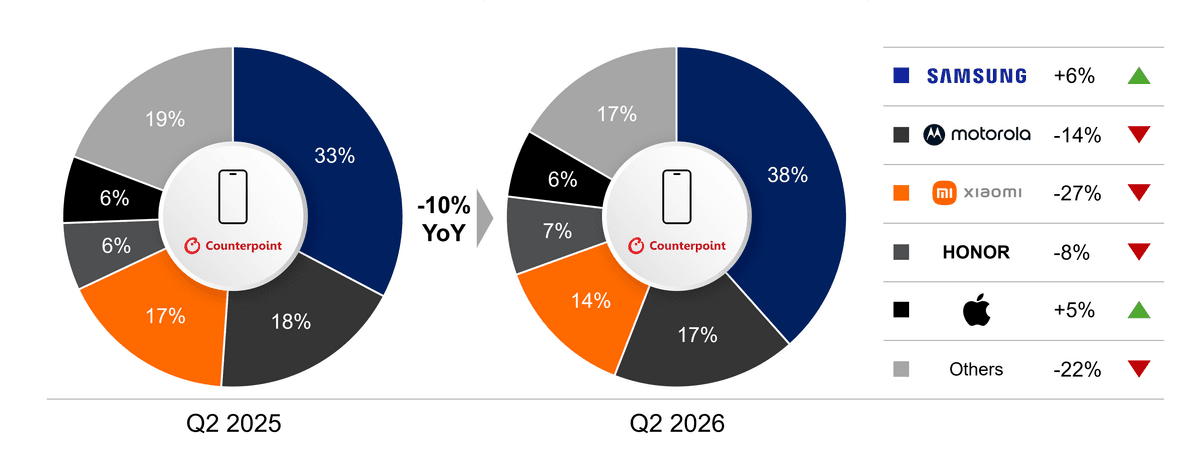
- LATAM smartphone shipments declined 10% YoY in Q2 2026, reflecting the memory shortage and pullback that followed vendors’ inventory buildup in Q1 ahead of anticipated price adjustments.
- Samsung strengthened its regional leadership, growing 6% YoY. The brand regained the number one position in Colombia, Peru, and Ecuador by flooding the markets with inventory and aggressive promotions.
- Apple grew 5% YoY in Q2 2026, supported by sustained demand for the premium product.
- Motorola, Xiaomi and Honor recorded the steepest declines among the top five OEMs, as their exposure to entry and mid-range price segments, most impacted by price actions, continued to weigh on volumes.
Guadalajara, Seoul, Beijing, Buenos Aires, Hong Kong, London, New Delhi, San Diego, Taipei, Tokyo – August 20, 2026
Latin America smartphone shipments contracted 10% YoY in Q2 2026, according to Counterpoint Research’s latest Market Monitor report, mainly driven by the ongoing memory shortage. The quarter posted the largest YoY decline since Q3 2023, when the post-pandemic economic recession and high inventories triggered a double-digit decline in smartphone shipments.
LATAM Smartphone Shipments by OEM, Q2 2025 vs Q2 2026 YoY
Commenting on the market dynamics, Principal Analyst Tina Lu said, “The Latin America smartphone market faced a challenging second quarter 2026. Memory shortages worsened, and SoC prices climbed throughout the quarter. Conversely, currency appreciation across several LATAM currencies helped soften the price hike. Thus, OEMs only partially passed the Bills of Materials (BoM) cost increase, reducing the price rise effect on buyers. However, the impact fell hardest on the entry and mid‑tier price bands, which account for three out of every four smartphones sold in the region. Furthermore, the inventory overhang from Q1 2026 and the economic headwinds across major markets dampened shipments, leading to a double‑digit decline.”
Samsung sustained its regional lead in Q2 2026, posting 6% YoY growth, at the expense of Motorola, Xiaomi and Honor. Samsung regained the top brand position in Colombia, Ecuador, and Peru, with a 38% share of total Latin American smartphone shipments. Samsung’s gains were supported by product availability, especially the Galaxy A Series and the Galaxy S series, strong presence in physical and online channels, and aggressive discounts.
Apple shipments increased 5% YoY. This performance was driven by the brand’s decision to absorb the price hike, alongside consistent demand for the iPhone 17 Pro Max. The iPhone 17e continued to build momentum during Q2 following its launch in late March, while legacy models sustained steady demand. Apple leads LATAM’s high‑end and premium price segments (>$600) with around a 51% share, while Samsung stands as the only significant competitor, reaching about 40% of the segment.
Motorola recorded a 14% YoY decline in Q2 2026 shipments. However, its ASP increased as the brand increased media exposure through its FIFA World Cup 2026 partnership and refreshed multiple product lines across the G Series, Edge lineup, and Razr families in Q1. The ASP increase offset the reduced volume. Motorola remains the second‑largest brand in the region.
Commenting on Xiaomi and Honor’s performance, Senior Analyst Benjamin Corona said, “Both brands rely on the entry and mid‑range segments, which are the categories that are most sensitive to the rising memory prices. Xiaomi opted to strategically prioritize the product supply of its core market in China, which constrained regional availability and contributed to a 27% YoY decline. While HONOR dropped 8% YoY, pressured by ongoing memory supply challenges and resulting price increases.”
Besides the memory shortage crisis, presidential elections held in Colombia last May and the elections planned in Brazil for October this year contributed to a more conservative consumption stance, further influencing the overall result. In addition, Colombia, Mexico and Brazil, the top three smartphone markets, faced rising inflationary pressure that weakened consumers' wallets and reduced overall purchasing power.
The memory shortage and resulting price pressures are expected to persist through the second half of 2026, with signs of recovery beginning in 2028. According to the latest Counterpoint Smartphone Market & Forecast Notes, the central view remains that memory supply and pricing dynamics, rather than underlying consumer demand, will be the primary determinant of smartphone market performance over the next 18-24 months.
About Counterpoint Research
Counterpoint Research is a global market research firm specializing in products across the technology ecosystem. We advise a diverse range of clients – from smartphone OEMs to chipmakers and channel players to Big Tech – through our offices located in the world's major innovation hubs, manufacturing clusters and commercial centers. Our analyst team, led by seasoned experts, engages with stakeholders across the enterprise – from the C-suite to professionals in strategy, analyst relations (AR), market intelligence (MI), business intelligence (BI), product and marketing – to deliver services spanning market data, industry thought leadership and consulting. Our core areas of coverage include AI, Automotive, Consumer Electronics, Displays, eSIM, IoT, Location Platforms, Macroeconomics, Manufacturing, Networks and Infrastructure, Semiconductors, Smartphones and Wearables. Visit our Insights page to explore our publicly available market data, insights and thought leadership, and to understand our focus, meet our analysts and start a conversation.

