LG Electronics has finally decided to consider withdrawal of its smartphone business, something which has been rumored for a while. This move, in turn, has led to speculations about downsizing or sale of the smartphone business. But whatever may be the final decision, it would be interesting to trace the company’s journey before reaching this point.
LG was once the third-largest handset manufacturer globally. In 2009, just before the smartphone market started taking off, LG sold nearly 120 million feature phones. In 2010, LG entered the smartphone market in earnest with the launch of Android-based smartphone Optimus. However, this entry came relatively later than Apple and Samsung’s. Also, for a while after that, LG adopted its OS from Microsoft instead of Android from its ‘rival’ Google. This made many existing users turn away from LG.

However, LG sought to turn around by launching the G series in 2013 to take on the Samsung Galaxy S. The G3 and G4 models performed well and the market share seemed to be growing again. But the 2016 experiment of launching a modular smartphone, the G5, didn’t click with the users and LG’s decline started from there.
The market share of LG smartphones has continued to decline after reaching about 4% in the second quarter of 2017. It has been below 2% since the third quarter of 2019.
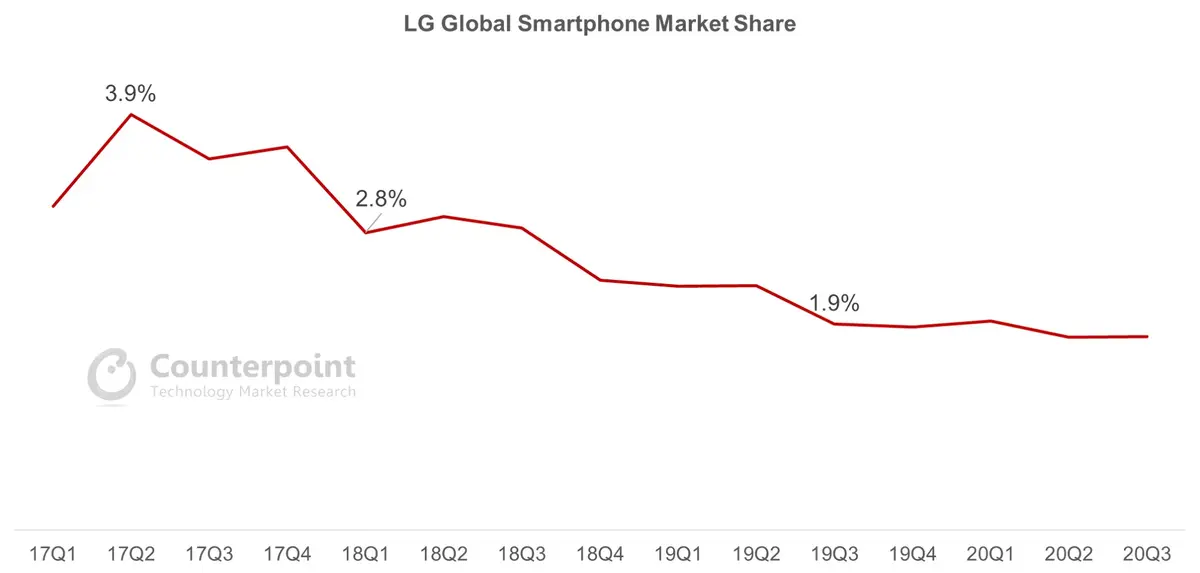
In addition to the modular smartphone, LG has been continuously releasing somewhat experimental models such as the V50 ThinQ (May 2019) and the dual-screen LG Wing (October 2020). Even as these models have failed to gain much market share, overall profitability has deteriorated due to the decrease in flagship sales. This, in turn, has led to a decrease in investment for new products, including new flagship launches.
Let us have a look at LG’s smartphone sales by region.

North America and Latin America are LG’s biggest markets, accounting for more than 80% of its smartphone sales. However, even here its share has been falling:
- LG’s share in the US smartphone market in Q3 2020: 12% (16% in 2018)
- LG’s share in the Latin American smartphone market in Q3 2020: 4% (8% in 2018)
With the competitiveness of its flagships weakened, LG’s market share has a higher proportion of the mid-to-low price segment in the US and Latin America. As a result, it faces fierce competition from brands such as Alcatel and Motorola, with Samsung’s A series clearly ahead of it.
LG’s models priced at $150 or less (based on wholesale price) accounted for 64% of its total sales in Q3 2020. This is a 5 percentage points increase from two years ago. As mentioned earlier, the sales decrease in premium models led to a decline in profitability. To enhance profitability, LG increased ODM share, which eventually led to a structure in which the share of mid-to-low priced products increased.
LG, which seemed unlikely to give up its smartphone business despite rumors circulating to this effect over the past few years, has now decided to do something about it before it is too late. The key factors contributing to this move are:
- The slump in the smartphone sector, which contrasts with the record sales reported by other sectors such as home appliances, is even more noticeable.
- The Velvet and Wing models, which were supposed to be the next big killer models, also reported disappointing numbers.
- The profit did not improve, despite the measures such as relocation of production bases to Vietnam and expansion of ODM share.
It seems no more cards remain to be used at LG after trying various plans. However, some questions do crop up:
- What if LG had used an online-focused distribution strategy (just like realme)?
- What if LG had developed a more grounded and practical 10-million-seller model with a reasonable price (just like OnePlus) than a high-risk experimental flagship strategy such as a dual-screen phone?
- What if LG had focused on the mid-to-low segment (just like HONOR) rather than flagships?
However, all these are matters of conjecture. We will have to wait till early February, when the outline of LG’s direction for its smartphone business will be revealed, before commenting on the topic further.

