ENG
Insight

Global Smartphone Revenue Up 7% in Q2 2026 Despite Shipment Slump; Apple Hits Revenue Share Peak

0
July 31, 2026
  • Global smartphone revenue grew 7% YoY in Q2 2026 driven by consistent price hikes by OEMs and increasing mix of premium devices.
  • The average selling price (ASP) grew 17% YoY in Q2 2026, supported by resilient demand for premium devices and broad-based price hikes by OEMs.
  • Apple's revenue rose the fastest among major brands, climbing 22% YoY to reach its highest-ever Q2 levels, supported by resilient demand while avoiding price hikes.
  • Samsung ranked second with a 16% revenue share in Q2 2026, as revenue grew 9% YoY, driven by strong regional growth in North America (NAM) and Middle East & Africa (MEA).


Beijing, Berlin, Buenos Aires, Fort Collins, Hong Kong, London, New Delhi, Seoul, Taipei, Tokyo - July 31, 2026

Global smartphone revenue grew 7% YoY in Q2 2026 to a record high of $109 billion, marking the highest-ever second-quarter revenue despite a decline in shipments, according to Counterpoint Research's latest Market Monitor Service. The disconnect between revenue and volume was driven by higher average selling prices (ASPs), which grew 17% YoY to a second quarter record of $400, underpinned by sustained consumer shift towards the premium segment. The ASP growth was also a result of memory-driven price hikes across Android OEM portfolios.

Commenting on the market dynamics, Senior Analyst Shilpi Jain said, “The global smartphone market has entered a new phase where shipments are no longer the primary driver of growth; instead, value has become the key growth lever, with rising component costs acting as a catalyst. With the entry tier shrinking and facing cost pressures, most OEMs are shifting away from volume-driven strategies, passing higher Bill of Materials (BOM) costs on to consumers, upselling higher-storage and higher-configuration models, and focusing on the premium segment. OEMs also expanded accessibility through instalment plans, aggressive EMI schemes, and trade-in offers, particularly in emerging markets where upfront affordability remains the key barrier to owning premium devices.”

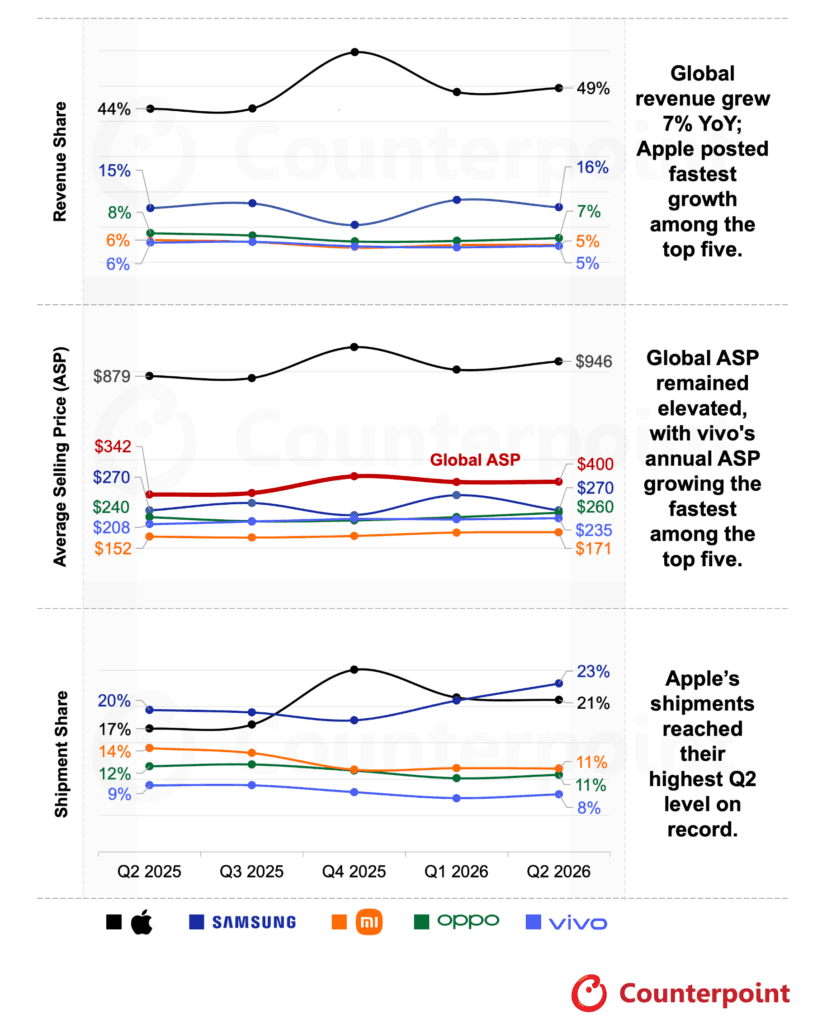
Global Smartphone Market by Revenue Share, Average Selling Price, Shipments Share in Q2, 2026

Global Smartphone Market by Revenue Share, Average Selling Price, Shipments Share in Q2, 2026
Source: Counterpoint Market Monitor Service Preliminary Data


*OPPO includes OnePlus and realme in all quarters shown. ASP is Based on Wholesale Price

Apple hit its highest-ever second-quarter revenue share of 49% in Q2 2026. The brand’s revenue rose 22% YoY during the quarter, supported by a 13% increase in shipments and 8% growth in ASP.

Commenting on Apple's performance, Research Director Tarun Pathak said, "Apple's growth was led by the sustained demand for the iPhone 17 lineup, particularly the base iPhone 17 and iPhone 17 Pro Max, which kept the brand’s mix skewed toward premium. Unlike peers that pushed through steep price increases, Apple kept pricing largely stable, reflecting its ability to absorb rising BOM costs and remain insulated from the memory crisis. However, Apple will likely increase prices in the coming quarters. This discipline strengthened Apple’s competitive position, enabling growth in both value and volume even as much of the market contracted. Regionally, China, Europe and emerging markets were the standout performers, as stable pricing improved Apple’s relative value proposition amid widespread Android price increases."

Samsung ranked second in the market, capturing a 16% revenue share in Q2 2026, helped by strong growth in both revenue and shipments, which rose 9% YoY each. Meanwhile, ASP remained relatively flat. Higher shipments were supported by stable demand across the Galaxy A-series, while the Galaxy S26 series’ continued momentum strengthened the brand’s premium performance. Regionally, growth was led by a particularly strong rise in shipments in the Middle East and Africa, along with double-digit percentage growth in North America, helping Samsung expand both shipments and revenue during the quarter. Samsung’s vertical integration and better control over component sourcing also helped it control growing input costs and maintain competitive pricing, contributing to a stable ASP despite selective price increases across its portfolio.

Xiaomi witnessed the steepest shipment decline among the top five brands, falling 26% YoY in Q2 2026. The decline also weighed on revenue, which tumbled 17% YoY, despite a significant 13% YoY increase in ASP as the company pushed toward higher-value devices. Xiaomi’s heavy reliance on entry- and mid-tier smartphones left it exposed to the memory crisis, as cost-driven price hikes weakened demand faster than higher ASPs could offset lower volumes. In response, Xiaomi increased model prices, streamlined its portfolio, prioritized profitability over scale, and expanded its focus on premium and upper mid-tier smartphones.

OPPO and vivo’s revenues declined 10% YoY and 11% YoY, respectively, despite ASP growth of 9% and 13%, with vivo recording the fastest rise in ASP among the top five brands. Their exposure to price-sensitive segments and sharp shipment declines limited the benefits of higher pricing. Despite shipment declines, OPPO and vivo recorded an increase in ASP as weaker entry-level demand, portfolio price increases and disciplined portfolio management shifted their sales mix toward higher-value devices.

Moving ahead, with memory shortages and rising costs showing no near-term relief, OEMs are expected to continue hiking prices and shifting their mix toward higher-value tiers. Supply is increasingly becoming a binding constraint than demand, and more severe shipment declines are likely to be witnessed by the smartphone industry in H2 2026. Consequently, ASPs are expected to rise in the coming quarters as well.

About Counterpoint Research

Counterpoint Research is a global market research firm specializing in products across the technology ecosystem. We advise a diverse range of clients – from smartphone OEMs to chipmakers and channel players to Big Tech – through our offices located in the world's major innovation hubs, manufacturing clusters and commercial centers. Our analyst team, led by seasoned experts, engages with stakeholders across the enterprise – from the C-suite to professionals in strategy, analyst relations (AR), market intelligence (MI), business intelligence (BI), product and marketing – to deliver services spanning market data, industry thought leadership and consulting. Our core areas of coverage include AI, Automotive, Consumer Electronics, Displays, eSIM, IoT, Location Platforms, Macroeconomics, Manufacturing, Networks and Infrastructure, Semiconductors, Smartphones and Wearables. Visit our Insights page to explore our publicly available market data, insights and thought leadership, and to understand our focus, meet our analysts and start a conversation.

Receive our insightful weekly newsletter and stay ahead of the competition.

Author

Tarun Pathak

twitter_icon
linkedin_icon

Tarun is a Research Director with Counterpoint Research, based out of Gurgaon (near New Delhi). Tarun has 10 years of work experience with a key focus on the evolving mobile device ecosystem with specialties in Emerging Markets. He understands specific mobile industry nuances, helping clients to navigate through the rapidly changing technological trends. As a Telecom Analyst he has been quoted extensively by the leading media platforms. Tarun holds a Post Graduate Diploma in Management, specializing in International Business from the Amity International Business School and is a graduate in Physical Sciences from Jammu University, Jammu in the northern Indian state of Jammu & Kashmir.

Shilpi Jain

twitter_icon

Shilpi is a Senior Analyst with Counterpoint Research, based out of Gurgaon. She has more than 9 years of work experience in consulting and market research field. She closely tracks mobile devices and ecosystem at Counterpoint and led various research and consulting projects. She holds a Master's in Business Administration from Fore School of Management, specializing in Finance, and a Bachelor's degree in Economics from Daulat Ram College, Delhi University.