ENG
Insight

EV Outlook Revised Amid OEM Pullback, But Long-Term Fundamentals Remain Strong

0
April 20, 2026
  • EV outlook has been revised down to 50% of vehicles sold in 2035 from 65% earlier, reflecting a near-term slowdown.
  • Major automakers have collectively incurred over $70 billion in EV-related charges and losses.
  • Despite the near-term slowdown, sub-$70/kWh batteries and energy market disruption triggered by the Iran war are strengthening long-term EV economics.
  • Battery electric vehicles (BEVs) lead the transition, while extended-range electric vehicles (EREVs) and plug-in hybrid electric vehicles (PHEVs) are emerging as critical bridge vehicle types globally.


London, Seoul, Beijing, Berlin, Buenos Aires, Fort Collins, Hong Kong, New Delhi, Taipei, Tokyo – April 20, 2026

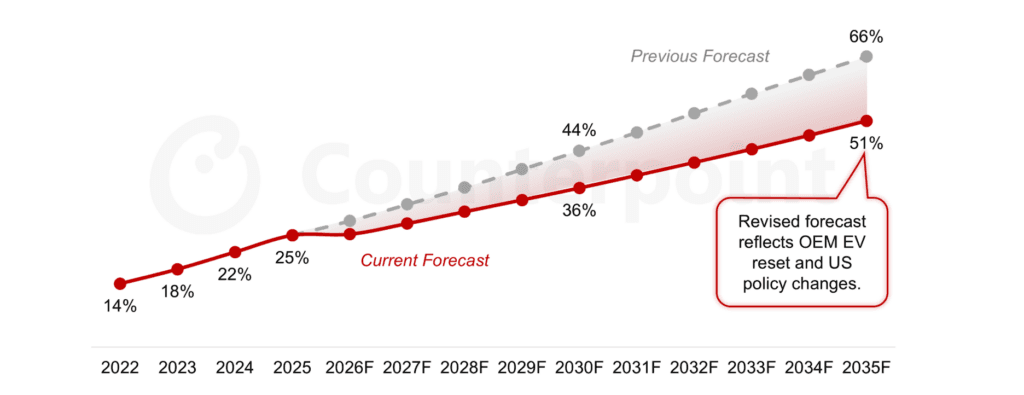
EV* share in global passenger vehicle sales is expected to reach 36% by 2030, growing at a CAGR of 10% between 2025 and 2030, according to Counterpoint Research’s latest Global Passenger Vehicle Forecast. Beyond 2030, EV market growth is expected to moderate as key regions reach maturity. However, EVs are still projected to capture only 50% of global passenger vehicle sales by 2035, growing at a steady CAGR of around 10% between 2030 and 2035. The latest forecast is a downward revision from Counterpoint’s previous forecast of 44% EV share by 2030 and 65% EV share by 2035, reflecting recent decisions by automotive OEMs to scale back their EV production plans.

Global EV Sales Share Forecast, 2035

EV include BEV, PHEV and EREV Source: Counterpoint Global Passenger Vehicle Forecast by Powertrain


Commenting on the current market situation, Associate Director Greg Basich said, “The global automotive industry stands at a crossroads, balancing near-term EV strategy adjustments with growing energy uncertainty. While automakers are pulling back on aggressive EV plans, geopolitical tensions and conflicts are quietly reinforcing the long-term case for electrification. Short-term setbacks in EV adoption are also being offset by structural tailwinds like falling battery costs and fuel supply uncertainty.”

Besides, the industry is adapting to evolving regulatory policies, rollback of EV mandates and discontinuation of EV subsidies.

Two contrasting dynamics

The global automotive industry is currently navigating two contrasting dynamics. On the one hand, automakers are recalibrating their EV strategies amid mounting losses and slower-than-expected adoption, but on the other hand, the Iran war has disrupted global energy markets, which will help the EV industry in the longer term.

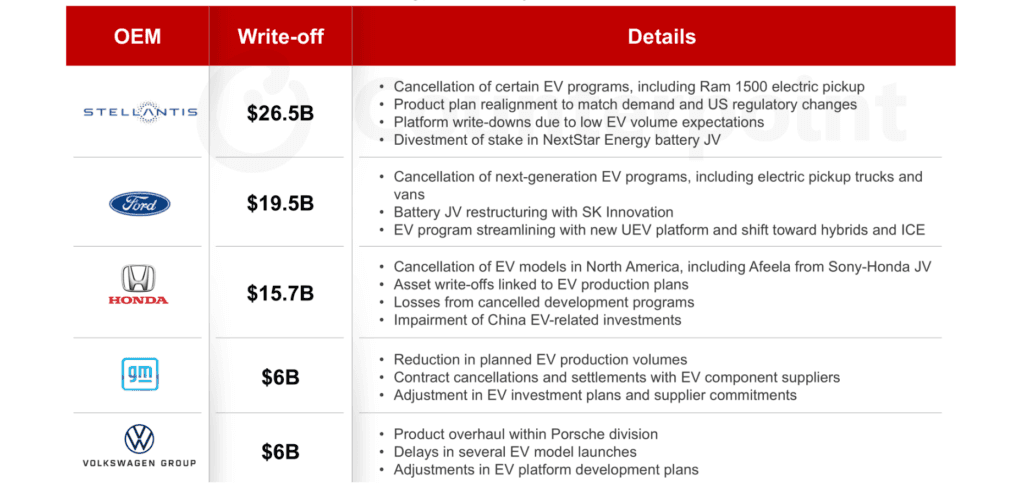
Companies including Ford, General Motors, Honda, Porsche, Maserati and Stellantis have collectively incurred over $70 billion in EV-related charges and losses. As a result, several OEMs are scaling back or delaying electrification plans, while others like Volvo Cars are revising long-term EV targets.

Greg continued, “Overall, the automotive industry is entering a shuffling phase as companies align their EV strategies with evolving market realities. Western OEMs have not abandoned EV development but have significantly scaled back earlier ambitious plans, adopting a more conservative and focused approach to EV launches. For instance, Ford has announced a new universal EV platform, while GM is revisiting the Chevrolet Bolt EUV. At the same time, Stellantis continues to strengthen its Leapmotor JV in Europe and Volkswagen and Audi are advancing EV platforms with Chinese partners and Rivian. Volvo has also delayed its 100% ZEV target beyond 2030, while Mercedes-Benz has increased its spending on combustion engines, reflecting a broader industry shift toward measured electrification strategies.”

On the opposite side, the war between the US, Israel and Iran has impacted the supply of oil from the Middle East. Longer term, this is expected to support EV demand as countries look to reduce their reliance on imported fuel. Besides, battery prices are expected to fall below $70/kWh by 2030 and reach $55/kWh by 2035, which could significantly reduce EV costs, given that batteries account for nearly 40% of total vehicle cost.

EV Strategy Reset: Major OEM Write-offs

*List not exhaustive Source: Compiled by Counterpoint Research


Given current market conditions, Counterpoint expects BEVs to account for around 25% of global passenger vehicle sales by 2030, while PHEVs are projected to reach around 8%. EREVs are also gaining momentum and are expected to expand beyond China into regions such as Southeast Asia and Europe.

Commenting on the technology outlook, Research Director Peter Richardson said, “By 2030, electrification will become more diversified, with BEVs leading the transition while PHEVs and EREVs play complementary roles. EREVs are emerging as a transitional solution, helping bridge the gap between conventional hybrids and full electrification as markets evolve.”

*EV here includes BEV (Battery EV), PHEV (Plug-in Hybrid EV) and EREV (Extended-Range EV)

The ‘Global Passenger Vehicle Forecast by Powertrain, 2025’ report is now available for purchase at report.counterpointresearch.com

Feel free to reach us at [email protected] for questions regarding our latest research and insights

About Counterpoint Research

Counterpoint Research is a global market research firm specializing in products across the technology ecosystem. We advise a diverse range of clients – from smartphone OEMs to chipmakers and channel players to Big Tech – through our offices located in the world's major innovation hubs, manufacturing clusters and commercial centers. Our analyst team, led by seasoned experts, engages with stakeholders across the enterprise – from the C-suite to professionals in strategy, analyst relations (AR), market intelligence (MI), business intelligence (BI), product and marketing – to deliver services spanning market data, industry thought leadership and consulting. Our core areas of coverage include AI, Automotive, Consumer Electronics, Displays, eSIM, IoT, Location Platforms, Macroeconomics, Manufacturing, Networks and Infrastructure, Semiconductors, Smartphones and Wearables. Visit our Insights page to explore our publicly available market data, insights and thought leadership, and to understand our focus, meet our analysts and start a conversation.

Follow Counterpoint Research

Twitter

LinkedIn

Receive our insightful weekly newsletter and stay ahead of the competition.

Author

Greg Basich

linkedin_icon

As Associate Director at Counterpoint Research, Greg Basich focuses on the automotive industry. Prior to joining Counterpoint Research, Greg worked at TechInsights and Strategy Analytics for a combined 11 years, providing market intelligence and advisory services to companies in the automotive electronics market and related verticals. Prior to his career as an analyst, Greg was a business-to-business journalist at Bobit Business Media for 13 years, focused on automotive interiors, aftermarket electronics, and the fleet market. Greg holds a bachelor’s degree in economics from the University of California, San Diego.

Peter Richardson

twitter_icon

Peter has 27 years experience in the mobile industry with extensive experience in market analysis and corporate development. Most recently Peter was Global Head of Market and Competitive Intelligence at Nokia. Here he headed a team responsible for analyzing and quantifying the industry. Prior to Nokia, Peter was an equity analyst at SoundView Technology Group. And before that he was VP and Chief Analyst of mobile and wireless research at Gartner. Peter’s early years in the industry were spent with NEC and Panasonic.