

- The US government has allowed NVIDIA to export its two-year old H200 Hopper AI GPUs to China though at a premium, complicating China’s chip self-sufficiency plan in the near- to mid-term.
- This comes at a time when China is actively taking steps to maximize domestic AI chip solutions utilization while minimizing dependence on US-based AI solutions.
- NVIDIA’s H200 is still a benchmark to beat and Beijing will likely increase pressure on Huawei, Cambricon, Biren, and Hygon to close the performance gap to reduce dependency.
Counterpoint’s AI, HPC and Semiconductor team of analysts has been holistically and closely tracking the AI accelerator market and connecting the dots on how different factors in this US-China AI race, including full-stack capabilities, ecosystem prowess, and geopolitics, is shaping the industry’s competitive dynamics.
On December 9, 2025, the Trump administration gave NVIDIA the green light to export its popular and highly capable Hopper H200 GPU chips to China, taking a U-turn from a blanket ban, which has sparked an interesting moment in this AI race. The ruling highlights two clear indications:
Firstly, NVIDIA now has the opportunity to somewhat recover its commercial foothold in China, giving the US an advantage in the AI race. Back in October, NVIDIA CEO Jensen Huang noted that the company’s share in China’s advanced AI-GPU market had dropped to 0% from roughly 95% due to earlier export rules. With the H200 now permitted, NVIDIA can execute a more calibrated global strategy – tiered products, selective exports, and stronger defense of its ecosystem against fast-rising Chinese chipmakers. This move could also potentially slow down China, which has been racing ahead with domestic AI chip self-sufficiency effort.
Secondly, the green light underlines Washington’s confidence in its technological lead. NVIDIA’s H200 is highly capable but its next-generation Blackwell flagship B200 delivers nearly triple the throughput, and the forthcoming Rubin in 2026 is expected to push performance much further beyond Blackwell. Therefore, the gap between the chips China can access and the ones the US deploys remains substantial. Essentially, the best and faster chips are still reserved for the US and others, barring China. NVIDIA would ideally prefer no restrictions but has to comply to the US export regulations to China.
NVIDIA’s Flagship Blackwell B200 Delivers 3.1x Higher Throughput Than H200
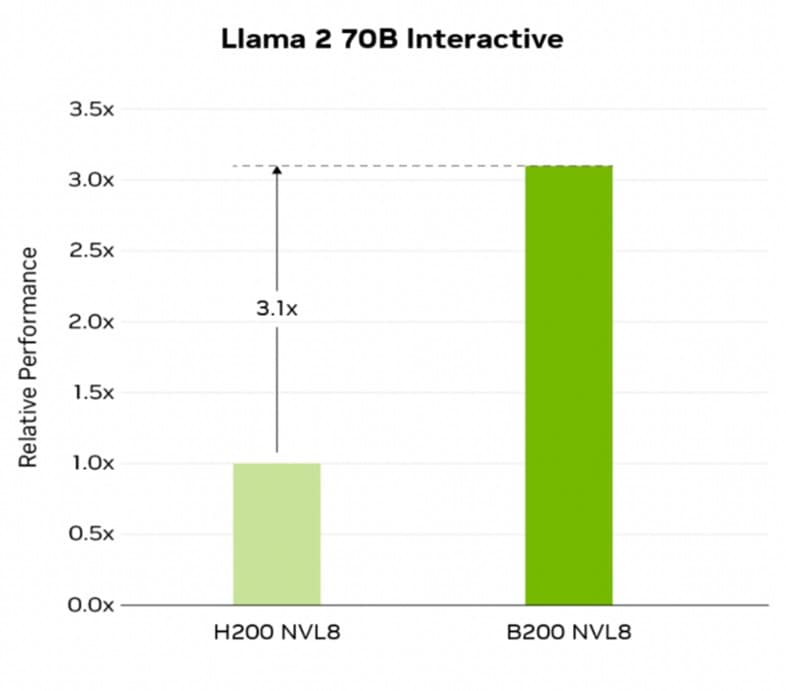
Source: NVIDIA
NVIDIA H200 Complicates China’s Chip Self-sufficiency Plan
This shift in US export control serves not only as a foreign-policy instrument, but also as a leverage in trade and a source of revenue. This complicates China’s push for chip self-sufficiency, which it has been trying to achieve for years. However, China has been increasing regulatory pressure on foreign chips. For example, ByteDance was reportedly barred from using additional NVIDIA GPUs in new data centers, and China’s state procurement lists now explicitly favor AI chips from domestic players like Huawei and Cambricon.
The dilemma is that NVIDIA’s two-generation-old H200 still outperforms most Chinese domestic chips by a wide margin. Even the strongest domestic alternative, Huawei’s 910C, reaches only about 76% of the H200’s overall processing performance and delivers roughly two-thirds of its memory bandwidth. Other leading Chinese players, such as Cambricon and Hygon, offer chips that lag even more. Consequently, the H200 is likely to remain highly attractive in China for some enterprises even at a premium, purely from a “time to market” perspective for its AI-powered software or platforms. This could help NVIDIA reclaim some of its lost share anywhere from the 10%-25% level, depending on how China allows what level of potential NVIDIA customers to procure the H200s.
How NVIDIA GPUs Can Coexist with China’s Domestic AI Chip Push
The likely scenario we are modeling at Counterpoint Research could be a win-win for everyone, for now.
1) NVIDIA’s GPUs for Training and Domestic AI Chips for Inference
China does not need to win the entire stack at once; it only needs to win the highest-volume layer first. Inference drives deployment, and deployment drives scale. Domestic chips are already “good enough” for high-volume inference workloads. The bottleneck is training compute, where NVIDIA remains well ahead – but the H200 is now accessible. This creates a practical equilibrium:
- Domestic chips handle the cost-sensitive, large-scale inference market.
- NVIDIA GPUs handle the capital-intensive training phase where China still needs frontier performance.
This split model makes sense because it maximizes domestic utilization while minimizing US dependence at the frontier. It also preserves ecosystem continuity: models can still be trained competitively while the domestic GPU stack catches up.
2) Using NVIDIA H200 Access as a Catalyst
Access to the NVIDIA H200 does not reduce the incentive for China to minimize dependance on US-based AI Accelerator solutions, rather it catalyzes it. With H200s legally available, the benchmark for domestic players becomes clearer and more immediate. Competing against a real NVIDIA product, not an unreachable one, creates tighter feedback loops and more aggressive performance targets.
This dynamic makes sense because competition accelerates capability development, rather than restricting it. By allowing Chinese firms to experience even two-generations-old NVIDIA chips’ performance firsthand, Beijing tightens the pressure on local champions to close the gap. In effect, the NVIDIA H200 becomes a forcing function – a tangible target to beat – rather than a dependency.
3) Advance Domestic ASIC chips
GPUs are general purpose; ASICs are inevitable. Once model architectures stabilize and workloads become better defined, ASICs offer performance-per-watt gains, cost efficiency, and lower supply-chain complexity. China’s manufacturing ecosystem is optimized for cost-driven iteration, which gives Chinese players a natural advantage in ASIC-focused acceleration (Huawei, Cambricon). If China cannot outpace NVIDIA in GPUs due to architectural head starts and CUDA lock-in, it can instead leapfrog into dedicated accelerators tailored for LLM and multimodal workloads. Case in point how Google is looking to have an alternative to NVIDIA with its very capable TPU stack optimized for its own workloads.
However, no access to TSMC is another challenge for China’s ecosystem. It is encouraging to see how SMIC and other players are looking to reach closer to in-process node, capacity, utilization rate though not in terms of fab yields yet.
4) Building Full Stack: Hardware + Software + Data + Ecosystem
NVIDIA leads on a global scale, not just because of chips, but because it owns the entire stack from CUDA, libraries, frameworks, developer tools, optimized models, and a developer and partner ecosystem. China would like to replicate the same vertically integrated approach but that is going to be a marathon.
This makes sense because ecosystems, not chips, determine long-term competitive power. If China can localize the entire loop, compute → frameworks → models → applications, it reduces dependence on US technology in a way no single chip breakthrough could achieve. Once the ecosystem is self-sustaining, the chip gap matters less because workloads grow around domestic platforms.
Wrapping up:
- For NVIDIA, the re-entry into China market helps the company boost its top-line and scale its still very capable two-generation-old NVIDIA H200s and revive the ecosystem.
- For NVIDIA partners, from Lenovo to Foxconn, to sell full rack systems to potential China customers and drive their business.
- This move showcases the Trump administration’s confidence in its US-based AI solutions, reinstating its AI leadership and potentially complicating China’s journey to AI chip self-sufficiency. In the process, the US will also charge a hefty 25% government fee on the sales of these chips to China.
- For China, this a double-edged sword. This is great news for some enterprises waiting for the highly capable NVIDIA chips to accelerate their time-to-market and for training their models. However, it could also somewhat slow down China’s enterprises that use less capable alternatives for training.
- A practical solution would be to use NVIDIA for training across some enterprises and domestic AI chips for broader large-scale inferencing.
- This split model makes sense because it maximizes domestic utilization while minimizing US dependence at the frontier.
- Taking a leaf from Google’s playbook with TPU, once model architectures stabilize and workloads become better defined, ASICs offer performance-per-watt gains, cost efficiency, and lower supply-chain complexity.
- Nevertheless, access to advance foundries such as TSMC to churn out advanced AI accelerator chips still remain a bottleneck for China.